Viscum: Difference between revisions
CSV import |
CSV import |
||
| Line 19: | Line 19: | ||
[[Category:Santalaceae]] | [[Category:Santalaceae]] | ||
{{pharmacology-stub}} | {{pharmacology-stub}} | ||
<gallery> | |||
File:Mistletoe_in_White_Poplar_1.jpg|Mistletoe in White Poplar | |||
File:Mistletoe_with_berries.jpg|Mistletoe with berries | |||
File:Viscum_coloratum_on_Aspen_about_Khabarovsk_Russia.jpg|Viscum coloratum on Aspen near Khabarovsk, Russia | |||
</gallery> | |||
Latest revision as of 04:04, 18 February 2025
Viscum is a genus of parasitic plants in the Santalaceae family, which is known for its significant role in various cultural traditions, medicine, and ecology. The most widely recognized species within this genus is Viscum album, commonly referred to as the European mistletoe. This genus is distributed across Europe, Asia, and Africa, adapting to a wide range of host trees and environments.
Description[edit]
Viscum species are evergreen, dioecious plants, which means they have separate male and female plants. They exhibit a distinctive growth habit, forming green, spherical masses on the branches of their host trees. These plants are characterized by their leathery leaves, forked branches, and waxy, white berries. The seeds within these berries are spread by birds, which eat the fruit and then excrete the seeds onto other trees, where they germinate and establish new plants.
Ecology[edit]
In their ecological role, Viscum species are both beneficial and detrimental. They are considered keystone species in some ecosystems, providing essential food and habitat for a variety of birds, insects, and other animals. However, as parasites, they extract water and nutrients from their host trees, which can weaken and sometimes kill the host if the infestation is severe.
Cultural Significance[edit]
The cultural significance of Viscum is profound, particularly for Viscum album. It has been used in various cultural rituals and traditions, most notably in Christmas celebrations where it is used as a decoration under which people kiss, stemming from ancient Druid and later Norse traditions. In addition to its cultural uses, Viscum has been employed in traditional medicine across various cultures to treat a range of ailments.
Medicinal Uses[edit]
In pharmacology, extracts from Viscum album have been studied for their potential therapeutic effects, including immunomodulatory and anti-cancer properties. Despite its traditional use, scientific evidence supporting the efficacy of mistletoe extracts in treating diseases is mixed, and research is ongoing.
Conservation[edit]
While some species of Viscum are abundant and even considered invasive in certain areas, others are rare and face threats from habitat loss and overharvesting. Conservation efforts are necessary to ensure the survival of these species and the ecological balance of their habitats.

-
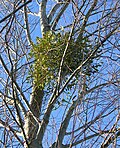 Mistletoe in White Poplar
 -
 Mistletoe with berries
 -
 Viscum coloratum on Aspen near Khabarovsk, Russia


