Frit: Difference between revisions
CSV import |
CSV import |
||
| Line 33: | Line 33: | ||
[[Category:Medicinal plants]] | [[Category:Medicinal plants]] | ||
{{Botany-stub}} | {{Botany-stub}} | ||
<gallery> | |||
File:Fritten_Glaswolleproduktion.jpg|Frit production in glass wool manufacturing | |||
File:Objects_in_the_Shape_of_Human_Heads_(4756068746).jpg|Objects in the shape of human heads | |||
File:Anchorage_Museum.jpg|Anchorage Museum | |||
</gallery> | |||
Latest revision as of 03:53, 18 February 2025
Fritillaria is a genus of spring flowering herbaceous bulbous perennial plants in the lily family, Liliaceae. The type species, Fritillaria meleagris, was first described in Europe in 1753. The name Fritillaria is derived from the Latin term fritillus, meaning dice-box, possibly referring to the checkered pattern on the flowers of some species. The genus is widely distributed in temperate regions of the Northern Hemisphere, in Europe, Asia, the Middle East, and North America.
Description[edit]
Fritillaria species vary greatly in size and color. The flowers are usually solitary, but in some species, they are borne in racemes. They are bell-shaped, with the petals and sepals usually displaying a checkered pattern in shades of purple, white, yellow, and green. The leaves are lanceolate or linear, with a glaucous or glossy finish. The bulbs of Fritillaria species are characterized by their scales, from which new bulbs can be propagated.
Habitat and Distribution[edit]
Fritillaria species are found in a wide range of habitats, from sea level to alpine regions. They prefer well-drained soils and are often found in grasslands, woodlands, and riverbanks. The distribution of Fritillaria encompasses Europe, North America, Asia, and the Middle East, reflecting the genus's adaptability to different environmental conditions.
Ecology[edit]
Fritillaria plants play a significant role in their ecosystems. They are pollinated by a variety of insects, including bees, which are attracted to their nectar. Some species of Fritillaria are adapted to specific pollinators, which has influenced their floral morphology. Additionally, Fritillaria bulbs are a food source for certain mammals, such as rodents and bears, in some regions.
Conservation[edit]
Several Fritillaria species are considered endangered or vulnerable due to habitat loss, over-collection, and climate change. Conservation efforts are underway in various countries to protect these species and their habitats. This includes habitat restoration, legal protection, and the cultivation of Fritillaria species in botanical gardens for conservation purposes.
Cultivation[edit]
Fritillaria species are popular in horticulture for their unique flowers and are cultivated worldwide. They require well-drained soil and a sunny to partially shaded location. Bulbs should be planted in the autumn for spring flowering. Some species, such as Fritillaria imperialis, are known for their distinctive crown of leaves and striking appearance.
Uses[edit]
Beyond their ornamental value, some Fritillaria species have been used in traditional medicine. For example, Fritillaria cirrhosa is used in Chinese medicine for its expectorant properties. However, the medicinal use of Fritillaria species should be approached with caution, as research on their efficacy and safety is limited.
See Also[edit]
References[edit]
<references />

-
 Frit production in glass wool manufacturing
 -
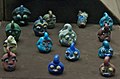 Objects in the shape of human heads
 -
 Anchorage Museum

.jpg)

