Forest produce (India): Difference between revisions
CSV import Tags: mobile edit mobile web edit |
CSV import |
||
| Line 39: | Line 39: | ||
{{forestry-stub}} | {{forestry-stub}} | ||
{{food-stub}} | {{food-stub}} | ||
<gallery> | |||
File:Mahua.jpg|Mahua flowers and fruits | |||
File:Diospyros_melanoxylon_Tendu.jpg|Tendu leaves | |||
File:Medicinal_Plant_Cleistanthus_collinus.jpg|Cleistanthus collinus plant | |||
</gallery> | |||
Latest revision as of 03:50, 18 February 2025
Forest produce refers to the collection and harvesting of the natural resources found in forests in India. These resources include a variety of goods, ranging from timber and non-timber products to medicinal plants and wild foods. Forest produce plays a significant role in the livelihoods of many rural communities in India, contributing to their food security, income, and health care.
Types of Forest Produce[edit]
Forest produce in India can be broadly categorized into two types: timber and non-timber forest produce (NTFP).
Timber[edit]
Timber is one of the most significant forest produce in India. It includes various types of wood used for construction, furniture, and fuel. Some of the most commonly harvested timber species in India include teak, sal, and shisham.
Non-Timber Forest Produce (NTFP)[edit]
Non-Timber Forest Produce (NTFP) includes a wide range of products derived from forests that are not timber. These include fruits, nuts, seeds, bark, leaves, roots, and flowers. Some of the most commonly harvested NTFPs in India include bamboo, rattan, medicinal plants, honey, lac, gum, resin, animal products, etc.
Role in Livelihoods[edit]
Forest produce plays a crucial role in the livelihoods of many rural communities in India. It provides them with food, fuel, medicine, and materials for construction and handicrafts. In addition, the sale of forest produce also provides an important source of income for these communities.
Legal Framework[edit]
The collection and trade of forest produce in India is governed by various laws and regulations. The most significant of these is the Forest Rights Act (FRA) of 2006, which recognizes the rights of forest-dwelling communities to collect, use, and sell minor forest produce.
Challenges[edit]
Despite its importance, the collection and trade of forest produce in India face several challenges. These include overexploitation, lack of market access, low prices, and legal restrictions.
See Also[edit]
.svg)

-
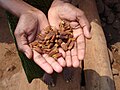 Mahua flowers and fruits
 -
 Tendu leaves
 -
 Cleistanthus collinus plant


