Petasites frigidus: Difference between revisions
CSV import |
CSV import |
||
| Line 22: | Line 22: | ||
[[Category:Asteraceae]] | [[Category:Asteraceae]] | ||
{{Flora-stub}} | {{Flora-stub}} | ||
== Petasites_frigidus == | |||
<gallery> | |||
File:Petasites_frigidus_1925.JPG|Petasites frigidus in bloom | |||
File:Petasites_frigidus_1030.JPG|Close-up of Petasites frigidus leaves | |||
File:Petasitesfrigidus.jpg|Petasites frigidus in its natural habitat | |||
</gallery> | |||
Revision as of 02:16, 18 February 2025
Petasites frigidus, commonly known as Arctic sweet coltsfoot or palmate coltsfoot, is a species of perennial plant in the Asteraceae family. It is native to the Arctic regions of North America, Asia, and Europe, and is known for its distinctive, palmate leaves and small, clustered flowers.
Description
Petasites frigidus is a herbaceous plant that grows up to 60 cm tall. Its leaves are large and palmate, with a diameter of up to 20 cm. The plant produces clusters of small, yellow or white flowers in early spring, before the leaves fully develop. The flowers are followed by fluffy, white seed heads that are dispersed by the wind.
Habitat and Distribution
Petasites frigidus is found in a variety of habitats, including wetlands, bogs, and alpine tundra. It is particularly common in areas with moist, well-drained soil and partial to full shade. The plant's range extends from the Arctic Circle south to the northern parts of the United States and Europe, and east to Asia.
Uses
Historically, Petasites frigidus has been used in traditional medicine by various indigenous peoples. The leaves were often used to treat coughs and respiratory ailments, while the roots were used for digestive problems. Today, the plant is primarily used for ornamental purposes, particularly in rock gardens and wildflower gardens.
Conservation Status
Petasites frigidus is not currently considered to be at risk of extinction. However, like many Arctic species, it may be threatened by climate change and habitat loss.
See Also

This flora-related article is a stub. You can help WikiMD by expanding it.
Petasites_frigidus
-
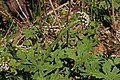 Petasites frigidus in bloom
 -
 Close-up of Petasites frigidus leaves
 -
Petasites frigidus in its natural habitat


