Fleur de sel: Difference between revisions
CSV import |
CSV import |
||
| Line 26: | Line 26: | ||
[[Category:French cuisine]] | [[Category:French cuisine]] | ||
{{food-stub}} | {{food-stub}} | ||
<gallery> | |||
File:FleurDeSel.JPG|Fleur de sel crystals | |||
File:Hamla_Mourad_11.jpg|Salt harvesting in progress | |||
File:Guérande_-_Comparaison_en_Fleur_de_sel_et_Gros_sel.JPG|Comparison of fleur de sel and coarse salt | |||
</gallery> | |||
Latest revision as of 02:16, 18 February 2025
Fleur de sel (Flower of Salt in English) is a type of sea salt that forms as a thin, delicate crust on the surface of seawater as it evaporates. Fleur de sel is harvested by hand, using traditional methods that have been in use since ancient times. It is considered a gourmet product and is used as a finishing salt to flavor and garnish food.
History[edit]
The practice of harvesting fleur de sel dates back to at least the 7th century, with records of salt production in the Guérande region of France dating back to the 9th century. The salt was traditionally harvested by salt workers, known as paludiers, who would rake the thin crust of salt off the surface of the water in the salt pans.
Production[edit]
Fleur de sel is produced in several countries, including France, Portugal, Spain, and Japan. The process involves collecting the thin layer of salt that forms on the surface of salt evaporation ponds. This is done by hand, using a rake or a sieve. The salt is then dried in the sun and wind before being packaged for sale.
Culinary Use[edit]
Fleur de sel is prized for its delicate flavor, moist texture, and the slight crunch it adds to dishes. It is used as a finishing salt, meaning it is added to dishes just before serving, rather than during cooking. It is often used on grilled meats, in salads, and on baked goods. It is also used in some types of chocolate and other confections.
Health and Nutrition[edit]
Like all sea salts, fleur de sel is rich in minerals, including magnesium, calcium, potassium, and iodine. However, because it is used sparingly as a finishing salt, it does not contribute significantly to dietary intake of these nutrients.
See Also[edit]
References[edit]
<references />

-
 Fleur de sel crystals
 -
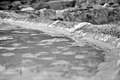 Salt harvesting in progress
 -
 Comparison of fleur de sel and coarse salt


