Volunteer (botany): Difference between revisions
CSV import |
CSV import |
||
| Line 34: | Line 34: | ||
<references /> | <references /> | ||
{{dictionary-stub1}} | {{dictionary-stub1}} | ||
<gallery> | |||
File:Volunteer_sunflowers.jpg|Volunteer sunflowers in a field | |||
File:Maize_in_soybean_field,_Monroe_Township_cropped.jpg|Volunteer maize in a soybean field | |||
</gallery> | |||
Latest revision as of 02:15, 18 February 2025
Volunteer (Botany)[edit]
A Volunteer in botany refers to a plant that grows on its own, rather than being deliberately planted by a gardener. These plants are often the result of seeds or bulbs that self-sow, or they may sprout from pieces of roots or tubers left in the ground from previous seasons.
Origin of Volunteers[edit]
Volunteer plants can originate from a variety of sources. They may sprout from seeds that have been dispersed by wind, water, or animals. They can also grow from bulbs, tubers, or pieces of roots that have been left in the ground from previous seasons. In some cases, volunteer plants may also grow from seeds that have been inadvertently mixed in with other seeds.
Identification of Volunteers[edit]
Identifying volunteer plants can be a challenge, as they often resemble weeds or other unwanted plants. However, there are a few key characteristics that can help distinguish volunteers. These include the plant's location, its growth pattern, and its physical characteristics such as leaf shape, flower color, and seed type.
Management of Volunteers[edit]
The management of volunteer plants depends on whether they are considered beneficial or detrimental to the garden or farm. Beneficial volunteers, such as self-sowing flowers or vegetables, can be left to grow and reproduce. Detrimental volunteers, on the other hand, may need to be removed to prevent them from competing with intentionally planted crops.
Impact on Biodiversity[edit]
Volunteer plants can have a significant impact on biodiversity. They can contribute to genetic diversity by introducing new traits into a population. However, they can also pose a threat to biodiversity if they become invasive and outcompete native species.
Conclusion[edit]
In conclusion, volunteer plants play a significant role in botany. They can contribute to biodiversity, provide unexpected benefits, and pose challenges for gardeners and farmers. Understanding and managing these plants can help ensure a healthy and productive garden or farm.
See Also[edit]
References[edit]
<references />

-
 Volunteer sunflowers in a field
 -
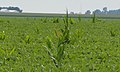 Volunteer maize in a soybean field


