Plantar reflex: Difference between revisions
CSV import Tags: mobile edit mobile web edit |
CSV import |
||
| Line 21: | Line 21: | ||
{{stub}} | {{stub}} | ||
{{dictionary-stub1}} | {{dictionary-stub1}} | ||
<gallery> | |||
File:Lawrence_1960_20.4-en.svg|Plantar reflex illustration | |||
File:BabinskiSign.jpg|Babinski sign demonstration | |||
File:Babinski-newborn.jpg|Babinski reflex in a newborn | |||
</gallery> | |||
Latest revision as of 02:12, 18 February 2025
Plantar reflex is a neurological reflex that occurs in response to stimulation of the sole of the foot. It is used in medicine to assess the integrity of the spinal cord and peripheral nerves of the lower limb.
Mechanism[edit]
The plantar reflex is elicited by stroking the lateral aspect of the sole of the foot with a blunt instrument. The normal response is a downward flexion of the toes. This is known as the flexor response.
In certain conditions, an abnormal response known as the Babinski sign can be observed. This is characterized by an upward extension of the big toe, often accompanied by fanning of the other toes. The Babinski sign is a sign of damage to the pyramidal tract, a group of nerve fibers that travel from the brain to the spinal cord.
Clinical significance[edit]
The plantar reflex is used in clinical practice to assess the integrity of the spinal cord and peripheral nerves. It is particularly useful in identifying damage to the pyramidal tract.
The presence of the Babinski sign can indicate a variety of neurological conditions, including stroke, multiple sclerosis, and spinal cord injury. It can also be seen in individuals with brain tumors or meningitis.
See also[edit]
 | |
|---|---|
 |
 |
| This medical article is a stub. You can help Wikipedia by adding missing information. |
-
 Plantar reflex illustration
 -
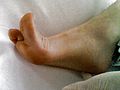 Babinski sign demonstration
 -
 Babinski reflex in a newborn


