Flow table test: Difference between revisions
CSV import Tags: mobile edit mobile web edit |
CSV import |
||
| Line 37: | Line 37: | ||
[[Category:Concrete]] | [[Category:Concrete]] | ||
{{construction-stub}} | {{construction-stub}} | ||
<gallery> | |||
File:Flow_Test_Equipment.JPG|Flow table test equipment | |||
File:Flow_Test_before.JPG|Flow table test before | |||
File:Flow_Test_after.JPG|Flow table test after | |||
</gallery> | |||
Latest revision as of 02:12, 18 February 2025
Flow Table Test
The Flow Table Test is a laboratory procedure used in the field of materials science and civil engineering to measure the flowability and workability of fresh concrete, mortar, and other cementitious mixtures. This test is crucial for ensuring that the mixtures used in construction projects have the appropriate consistency and fluidity for the intended application, thereby affecting the strength, durability, and finish quality of the constructed structures.
Overview[edit]
The Flow Table Test involves placing a sample of the material to be tested on a flat table that can be mechanically lifted and dropped a specified number of times. The flow of the material is then measured to determine its workability. The test is standardized by various international standards, including ASTM C1437 for hydraulic cement mortars and EN 12350-5 for concrete.
Procedure[edit]
- A specified amount of the test sample is placed in a cone-shaped mold on the center of the flow table.
- The mold is then lifted, allowing the sample to spread out on the table.
- The table is mechanically dropped from a fixed height a specific number of times (usually 25 drops in 15 seconds).
- The diameter of the spread sample is measured in two perpendicular directions.
- The average of these two measurements is taken as the flow index of the material.
Interpretation of Results[edit]
The flow index obtained from the Flow Table Test provides an indication of the material's workability. A higher flow index indicates a more fluid mixture, which is easier to work with but may be more prone to segregation and bleeding. Conversely, a lower flow index suggests a stiffer mixture, which might be more difficult to work with but could lead to higher strength and less segregation.
Applications[edit]
The Flow Table Test is widely used in the construction industry to:
- Assess the workability of fresh concrete and mortar.
- Determine the suitability of a mixture for a particular construction process (e.g., casting, pumping).
- Evaluate the effect of additives, such as superplasticizers, on the flowability of cementitious mixtures.
Limitations[edit]
While the Flow Table Test provides valuable information about the flowability of a mixture, it has some limitations:
- It may not fully replicate the conditions under which the material will be used in the field.
- The results can be influenced by the skill and technique of the operator.
- It is primarily suitable for mixtures with relatively high flowability.
See Also[edit]
This construction related article is a stub. You can help WikiMD by expanding it.
-
 Flow table test equipment
 -
 Flow table test before
 -
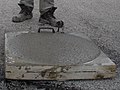 Flow table test after


