Drinking the Kool-Aid: Difference between revisions
CSV import Tags: mobile edit mobile web edit |
CSV import |
||
| Line 27: | Line 27: | ||
[[Category:Psychological manipulation]] | [[Category:Psychological manipulation]] | ||
{{Sociology-stub}} | {{Sociology-stub}} | ||
<gallery caption="Drinking_the_Kool-Aid"> | |||
File:Jonestown_beverages.jpg|Jonestown beverages | |||
File:Kool-Aid_(5583740815)_(1).jpg|Kool-Aid | |||
</gallery> | |||
Latest revision as of 02:11, 18 February 2025
Drinking the Kool-Aid is a phrase that has transcended its literal meaning to become a metaphorical expression in American English. It signifies a person or group's unquestioning obedience or loyalty to a cause, leader, or directive, often to the point of potential harm or detriment. The origin of this phrase is deeply tragic, rooted in a mass murder-suicide event that occurred in 1978 at Jonestown, Guyana, involving the followers of the Peoples Temple, led by Jim Jones.
Origin[edit]
The term "Drinking the Kool-Aid" derives from the Jonestown Massacre on November 18, 1978. Over 900 members of the Peoples Temple, a cult led by Jim Jones, died after consuming a drink mixed with cyanide. Contrary to popular belief, the poisoned beverage was not actually "Kool-Aid" but rather its less popular competitor, "Flavor Aid." The event remains one of the largest mass deaths in a single event and has since been etched into public consciousness, giving rise to the phrase.
Cultural Impact[edit]
The phrase has permeated various aspects of culture, including politics, business, and media, to describe blind, uncritical conformity. Its usage often carries a negative connotation, suggesting that the person or group referred to is following a directive without considering the consequences or exercising independent thought.
Criticism and Sensitivity[edit]
The use of the phrase "Drinking the Kool-Aid" has been criticized for its insensitivity towards the victims of the Jonestown tragedy. It is argued that the term trivializes the circumstances of their deaths, reducing a complex human tragedy to a catchphrase. Discussions about the ethical implications of the phrase's usage highlight the need for sensitivity and respect towards historical events and their impact on survivors and victims' families.
Psychological Perspective[edit]
From a psychological standpoint, the phenomenon described by "Drinking the Kool-Aid" can be linked to concepts such as groupthink, cult of personality, and social influence. These frameworks help understand the mechanisms by which individuals may surrender their autonomy in favor of group cohesion or in obedience to authority figures.
In Popular Media[edit]
The phrase has been referenced in various forms of media, including films, television shows, and literature, often to critique or satirize situations where blind loyalty is observed. Its usage in popular culture further cements its place in the American lexicon, albeit not without controversy regarding its appropriateness.
See Also[edit]

- Drinking_the_Kool-Aid
-
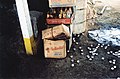 Jonestown beverages
 -
 Kool-Aid

_(1).jpg)
