Cirsium vulgare: Difference between revisions
CSV import Tags: mobile edit mobile web edit |
CSV import |
||
| Line 27: | Line 27: | ||
{{Flora-stub}} | {{Flora-stub}} | ||
== Cirsium_vulgare == | |||
<gallery> | |||
File:Mooie_bloeiwijze_van_een_Speerdistel_(Cirsium_vulgare)_03.jpg|Cirsium vulgare in bloom | |||
File:20160729Cirsium_vulgare5.jpg|Cirsium vulgare | |||
</gallery> | |||
Latest revision as of 02:07, 18 February 2025
Cirsium vulgare, commonly known as spear thistle, is a species of the genus Cirsium, within the family Asteraceae. Native to regions of Europe and Asia, it is now widespread throughout North America and Australia due to human introduction.
Description[edit]
Cirsium vulgare is a biennial or sometimes perennial plant that can grow up to 1.5 meters tall. The plant is characterized by its spiny and hairy leaves, and its distinctive purple flower heads. The flowers are hermaphrodite, and are pollinated by bees, flies, lepidoptera, and beetles. The plant has a strong and deep taproot system, which allows it to survive in a variety of soil types and conditions.
Distribution and habitat[edit]
The spear thistle is native to the regions of Europe and Asia, but has been introduced to North America, Australia, and other parts of the world. It is commonly found in disturbed areas such as roadsides, pastures, and along riverbanks. The plant prefers sunny locations and can tolerate a wide range of soil types, from heavy clay to light sandy soils.
Ecology[edit]
Cirsium vulgare plays a significant role in its ecosystem. It provides a source of nectar for several species of insects, and its seeds are eaten by birds. However, it is also considered a weed in many areas due to its ability to spread rapidly and outcompete native vegetation.
Uses[edit]
Historically, the spear thistle has been used for a variety of purposes. The young stems can be peeled and eaten, and the roots have been used as a coffee substitute. In traditional medicine, the plant has been used to treat a variety of ailments, including ulcers and cancers.
Control[edit]
Control of Cirsium vulgare is often necessary in areas where it is considered a weed. This can be achieved through a combination of mechanical methods, such as mowing and hand-pulling, and chemical methods, such as the use of herbicides.
See also[edit]

This flora-related article is a stub. You can help WikiMD by expanding it.
Cirsium_vulgare[edit]
-
 Cirsium vulgare in bloom
 -
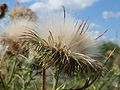 Cirsium vulgare
_03.jpg)

