TP63: Difference between revisions
CSV import |
CSV import |
||
| Line 30: | Line 30: | ||
[[Category:Oncology]] | [[Category:Oncology]] | ||
{{gene-stub}} | {{gene-stub}} | ||
<gallery> | |||
File:P63_staining_on_prostate_cancer_tissue_using_antibody_clone_IHC063.jpg|P63 staining on prostate cancer tissue using antibody clone IHC063 | |||
File:Main_staining_patterns_on_immunohistochemistry.jpg|Main staining patterns on immunohistochemistry | |||
</gallery> | |||
Latest revision as of 02:04, 18 February 2025
TP63 is a gene that provides instructions for making a protein called tumor protein p63. This protein plays a crucial role in the development and maintenance of various tissues, especially before birth. The TP63 gene is part of a gene family that includes TP53 and TP73. These genes all produce tumor protein products that can prevent the formation of tumors by stopping cell growth and division too rapidly or under abnormal conditions.
Function[edit]
The tumor protein p63 produced from the TP63 gene is involved in the formation and differentiation of epithelial tissues. These tissues form a barrier on the surfaces and linings of structures throughout the body, including the skin, hair follicles, and glands. The p63 protein is also essential for the normal development of limbs, skin, and other tissues.
Genetic Changes[edit]
Mutations in the TP63 gene are responsible for several conditions that involve abnormalities of the skin, limbs, and other parts of the body. These conditions include Ectrodactyly, ectodermal dysplasia, and cleft lip/palate syndrome 3 (EEC3) and Ankyloblepharon-ectodermal dysplasia-clefting syndrome (AEC).
Clinical Significance[edit]
The TP63 gene is often mutated in squamous cell carcinomas, which are cancers that arise in epithelial tissues. These mutations are typically somatic, meaning they are acquired during a person's lifetime and are present only in tumor cells.
See Also[edit]
- TP53
- TP73
- Tumor protein p63
- Ectrodactyly, ectodermal dysplasia, and cleft lip/palate syndrome 3 (EEC3)
- Ankyloblepharon-ectodermal dysplasia-clefting syndrome (AEC)
References[edit]
<references group="" responsive="1"></references>

-
 P63 staining on prostate cancer tissue using antibody clone IHC063
 -
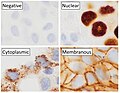 Main staining patterns on immunohistochemistry


