Craterization: Difference between revisions
CSV import Tags: mobile edit mobile web edit |
CSV import |
||
| Line 23: | Line 23: | ||
[[Category:Planetary science]] | [[Category:Planetary science]] | ||
{{medicine-stub}} | {{medicine-stub}} | ||
<gallery> | |||
File:Sedan_Plowshare_Crater.jpg|Sedan Plowshare Crater | |||
File:Kilauea_Lava_Lake_(12792432484).jpg|Kilauea Lava Lake | |||
</gallery> | |||
Latest revision as of 02:00, 18 February 2025
Craterization
Craterization is a geological process that involves the formation of craters on the surface of a celestial body, such as a planet or moon. This process is typically associated with impacts from meteoroids, asteroids, or comets. The resulting craters can vary in size and shape, depending on the size and velocity of the impacting object.
Formation[edit]
When a meteoroid, asteroid, or comet collides with a celestial body, it releases a tremendous amount of energy upon impact. This energy causes the surface material to be ejected outward, creating a depression known as a crater. The size and depth of the crater depend on factors such as the size and speed of the impacting object, as well as the composition of the surface material.
Characteristics[edit]
Craters can exhibit various features, including a raised rim, a central peak, and ejecta deposits surrounding the crater. The morphology of a crater can provide valuable information about the impact event and the geological history of the celestial body. Scientists study craters to understand the frequency and effects of impact events in the solar system.
Examples[edit]
One of the most well-known examples of craterization is the impact crater Chicxulub, located on the Yucatán Peninsula in Mexico. This crater is believed to have been formed by the impact of a large asteroid or comet approximately 66 million years ago. The Chicxulub impact event is thought to have contributed to the mass extinction of the dinosaurs.
Significance[edit]
Studying craters can provide insights into the geological processes that have shaped celestial bodies in the solar system. By analyzing the distribution and characteristics of craters, scientists can infer the history of impact events and their implications for the evolution of planets and moons.

-
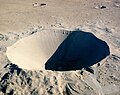 Sedan Plowshare Crater
 -
 Kilauea Lava Lake

.jpg)
