Wedge prism: Difference between revisions
CSV import Tags: mobile edit mobile web edit |
CSV import |
||
| Line 36: | Line 36: | ||
{{Optics-stub}} | {{Optics-stub}} | ||
<gallery> | |||
File:WedgePrism(IN_Tree).jpg|Wedge prism used to measure an in tree | |||
File:WedgePrism(BorderlineTree).jpg|Wedge prism used to measure a borderline tree | |||
File:WedgePrism(Out_Tree).jpg|Wedge prism used to measure an out tree | |||
</gallery> | |||
Latest revision as of 01:56, 18 February 2025
Wedge prism is an optical device with a triangular cross-section. It refracts light, bending it toward its thicker portion. Wedge prisms are used to redirect light beams and create prism spectrometers, as well as in various optical systems to correct image orientation and beam displacement.
Design and Function[edit]
A wedge prism's design is relatively simple, consisting of two flat surfaces inclined at an angle relative to each other. The angle between these surfaces, known as the wedge angle, determines the prism's ability to deflect light. When light enters the prism, it changes direction twice: once upon entry and again upon exit. This deviation is due to Snell's Law, which describes how light bends when it passes through materials of different refractive indices.
The amount of beam deviation depends on the wedge angle and the material's refractive index. By adjusting these parameters, optical engineers can design wedge prisms to meet specific requirements for beam steering applications.
Applications[edit]
Wedge prisms have a wide range of applications in optical engineering and photonics. Some of their most common uses include:
- Beam Steering: By aligning multiple wedge prisms, engineers can precisely control the direction of light beams. This technique is essential in optical communication, laser scanning, and LIDAR systems.
- Image Correction: In optical systems like binoculars and periscopes, wedge prisms correct image orientation, ensuring that the viewed image is upright and laterally correct.
- Dispersion: Although not as effective as dispersive prisms in separating light into its constituent colors, wedge prisms can still be used for minor dispersion effects in some optical instruments.
Types[edit]
Wedge prisms can be categorized based on their material or their specific application. Common materials include glass, plastic, and crystal (e.g., quartz and sapphire). The choice of material affects the prism's optical properties, such as its refractive index and dispersion.
Considerations[edit]
When designing or selecting a wedge prism for an optical system, several factors must be considered:
- Material: The optical properties of the prism's material, including refractive index and dispersion, will affect the device's performance.
- Wedge Angle: The angle between the prism's inclined surfaces determines the amount of light deviation. Precise control of this angle is crucial for applications requiring accurate beam steering.
- Surface Quality: Imperfections on the prism's surfaces can degrade image quality and reduce the efficiency of light transmission.
See Also[edit]
References[edit]
<references />

-
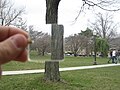 Wedge prism used to measure an in tree
 -
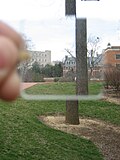 Wedge prism used to measure a borderline tree
 -
 Wedge prism used to measure an out tree
.jpg)
.jpg)
.jpg)
