Perciformes: Difference between revisions
CSV import |
CSV import |
||
| Line 26: | Line 26: | ||
{{stub}} | {{stub}} | ||
{{dictionary-stub1}} | {{dictionary-stub1}} | ||
<gallery> | |||
File:Kirnja.jpg|Perciformes | |||
File:Perciformes_01.jpg|Perciformes | |||
File:Pomacanthus_semicirculatus_1.jpg|Pomacanthus semicirculatus | |||
</gallery> | |||
Latest revision as of 01:51, 18 February 2025
Perciformes is the largest order of fishes and includes about 40% of all known species of fish. Perciformes are characterized by having two dorsal fins, usually separated or with the front one spiny and the back one soft-rayed. They are found in a variety of habitats, from freshwater to marine environments, and from the deep sea to high mountain streams.
Characteristics[edit]
Perciformes are typically characterized by two dorsal fins, the first one spiny and the second one soft-rayed. They also have a pair of pelvic fins with one spine and up to five soft rays, positioned under the pectoral fins and somewhat forward. Perciformes are usually carnivorous, feeding on smaller fish or invertebrates.
Distribution and habitat[edit]
Perciformes are found in a variety of habitats, from freshwater to marine environments, and from the deep sea to high mountain streams. They are most diverse in tropical seas, but are also found in other areas.
Taxonomy[edit]
The order Perciformes is divided into numerous suborders, families, and genera. Some of the most well-known families include the Percidae (perches), Serranidae (sea basses and groupers), and Sciaenidae (drums or croakers).
See also[edit]
References[edit]
<references />
External links[edit]
 | |
|---|---|
 |
 |
| This medical article is a stub. You can help Wikipedia by adding missing information. |
-
 Perciformes
 -
 Perciformes
 -
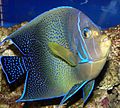 Pomacanthus semicirculatus


