Dutch baby pancake: Difference between revisions
CSV import |
CSV import |
||
| Line 30: | Line 30: | ||
[[Category:Brunch foods]] | [[Category:Brunch foods]] | ||
{{food-stub}} | {{food-stub}} | ||
<gallery> | |||
File:Dutchbaby-DSCN8394.JPG|A freshly baked Dutch baby pancake in a skillet | |||
File:DutchBabyWithSides.jpg|Dutch baby pancake served with sides | |||
File:David-eyres-pancake.jpg|David Eyre's pancake, a variation of the Dutch baby | |||
</gallery> | |||
Latest revision as of 01:48, 18 February 2025
Dutch Baby Pancake
A Dutch baby pancake, also known as a German pancake, a Bismarck, or a Dutch puff, is a sweet popover that is typically served for breakfast or brunch. The pancake is derived from the German Pfannkuchen and is made with eggs, flour, sugar, and milk, and usually seasoned with vanilla and cinnamon, although occasionally fruit or another flavoring is also added.
History[edit]
The Dutch baby pancake's name is derived not from the Netherlands, but from the Pennsylvania Dutch, who were actually of German descent. The "baby" in the name refers to the size of the pancake- it is a smaller, individual serving compared to a traditional pancake.
Preparation[edit]
The batter for a Dutch baby pancake is very thin, similar to a crepe batter. It is typically prepared in a cast iron or metal pan and then baked in the oven, rather than being fried on both sides like a traditional pancake. This allows the pancake to rise, and it often puffs up dramatically while cooking, which can make it a fun and impressive dish to serve.
Serving[edit]
Dutch baby pancakes are typically served hot out of the oven. They can be topped with a variety of ingredients, such as powdered sugar, syrup, fruit, or even savory toppings like cheese or bacon. The pancake itself is slightly sweet, but not overly so, which makes it a versatile base for a variety of toppings.
Variations[edit]
There are many variations of the Dutch baby pancake. Some recipes call for the addition of baking powder to help the pancake rise, while others rely solely on the eggs for leavening. Some people add fruit or other flavorings to the batter, while others prefer to add these as toppings after the pancake is cooked.
See also[edit]

-
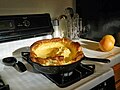 A freshly baked Dutch baby pancake in a skillet
 -
 Dutch baby pancake served with sides
 -
 David Eyre's pancake, a variation of the Dutch baby


