Cooksonia: Difference between revisions
CSV import |
CSV import |
||
| Line 34: | Line 34: | ||
[[Category:Prehistoric plant genera]] | [[Category:Prehistoric plant genera]] | ||
[[Category:Vascular plants]] | [[Category:Vascular plants]] | ||
<gallery> | |||
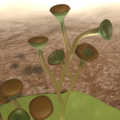
File:Cooksonia_NMNH.jpg|Cooksonia | |||
File:Cooksonia_pertoni.png|Cooksonia pertoni | |||
File:Cooksonia_sp._-_MUSE.jpg|Cooksonia sp. | |||
</gallery> | |||
Latest revision as of 01:45, 18 February 2025
Cooksonia[edit]
Cooksonia is an extinct genus of primitive vascular plants that lived during the Silurian and early Devonian periods, approximately 433 to 393 million years ago. It is one of the earliest known genera of land plants and is significant for its role in the evolution of terrestrial flora.
Description[edit]
Cooksonia plants were small, simple, and leafless, typically measuring only a few centimeters in height. They had a simple branching structure with dichotomous (forking) branches. The stems were cylindrical and bore terminal sporangia, which are structures that produce and release spores. The sporangia were typically round or oval and were located at the tips of the branches.
Anatomy[edit]
The anatomy of Cooksonia is characterized by its simple vascular system. The presence of vascular tissue is a key feature that distinguishes Cooksonia from non-vascular plants such as bryophytes. The vascular tissue in Cooksonia allowed for the transport of water and nutrients, which was a crucial adaptation for life on land.
Fossil Record[edit]
Fossils of Cooksonia have been found in various parts of the world, including Europe, North America, and South America. The widespread distribution of Cooksonia fossils indicates that these plants were among the first to colonize terrestrial environments.
Significance[edit]
Cooksonia is significant in the study of plant evolution because it represents one of the earliest known vascular plants. Its simple structure provides insights into the transition of plants from aquatic to terrestrial environments. The evolution of vascular tissue in Cooksonia and other early land plants was a critical step in the development of more complex plant forms.
Taxonomy[edit]
The genus Cooksonia was first described by the British paleobotanist William Henry Lang in 1937. The type species is Cooksonia pertoni. Several other species have been described, including Cooksonia hemisphaerica and Cooksonia cambrensis.
Extinction[edit]
Cooksonia became extinct by the end of the early Devonian period. Its extinction is part of a broader pattern of plant evolution and diversification that saw the rise of more complex plant groups, such as the lycophytes and ferns.
See Also[edit]
References[edit]
- Edwards, D. (1990). "The origin and early diversification of land plants: A cladistic study." In: Taylor, T.N., and Taylor, E.L. (eds.), Paleobotany: The Biology and Evolution of Fossil Plants. Academic Press.
- Kenrick, P., and Crane, P.R. (1997). The Origin and Early Diversification of Land Plants: A Cladistic Study. Smithsonian Institution Press.
-
 Cooksonia
 -
 Cooksonia pertoni
 -
 Cooksonia sp.


