2017 Uganda Marburg virus outbreak: Difference between revisions
CSV import |
CSV import |
||
| Line 41: | Line 41: | ||
[[Category:Health in Uganda]] | [[Category:Health in Uganda]] | ||
[[Category:2017 disease outbreaks]] | [[Category:2017 disease outbreaks]] | ||
<gallery> | |||
File:Ug-map.png|Map of Uganda | |||
File:Uganda_(orthographic_projection).svg|Orthographic projection of Uganda | |||
File:Marburg_virus.jpg|Marburg virus | |||
</gallery> | |||
Latest revision as of 01:42, 18 February 2025
2017 outbreak of Marburg virus in Uganda
2017 Uganda Marburg virus outbreak[edit]
The 2017 Uganda Marburg virus outbreak was a significant public health event involving the Marburg virus, a highly infectious and often fatal virus that causes Marburg virus disease. The outbreak occurred in the Kween District of Uganda and was officially declared by the Ugandan Ministry of Health in October 2017.
Background[edit]
Marburg virus is a member of the Filoviridae family, which also includes the Ebola virus. It is known for causing severe viral hemorrhagic fever in humans and non-human primates. The virus is transmitted to people from fruit bats and spreads among humans through human-to-human transmission via direct contact with the bodily fluids of infected individuals.
Outbreak details[edit]
The outbreak began in September 2017 when a 50-year-old woman from the Kween District was admitted to a local health facility with symptoms consistent with Marburg virus disease. She had a history of contact with bats in a cave, which is believed to be the source of the infection. The outbreak was confirmed by laboratory testing conducted by the Uganda Virus Research Institute.
The Ugandan Ministry of Health, in collaboration with the World Health Organization (WHO) and other partners, initiated a rapid response to contain the outbreak. Measures included the isolation of suspected cases, contact tracing, and public health education to prevent further transmission.
Response and containment[edit]
The response to the outbreak involved a multi-faceted approach:
- Isolation and treatment: Suspected and confirmed cases were isolated in designated treatment centers to prevent further spread of the virus.
- Contact tracing: Health workers identified and monitored individuals who had been in contact with confirmed cases to quickly detect any new infections.
- Public awareness campaigns: Efforts were made to educate the public about the symptoms of Marburg virus disease and the importance of seeking medical attention promptly.
- International support: The WHO and other international organizations provided technical and logistical support to the Ugandan health authorities.
Outcome[edit]
The outbreak was declared over in December 2017 after no new cases were reported for a period of 42 days, which is twice the maximum incubation period of the virus. The rapid response and effective containment measures were credited with preventing a larger epidemic.
Related pages[edit]
Gallery[edit]
-
 Map of Uganda
 -
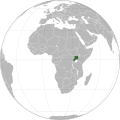 Orthographic projection of Uganda
 -
 Image of Marburg virus

.svg)

-
Map of Uganda
-
Orthographic projection of Uganda
-
Marburg virus
