Arrestin: Difference between revisions
CSV import |
CSV import |
||
| Line 39: | Line 39: | ||
[[Category:Signal transduction]] | [[Category:Signal transduction]] | ||
[[Category:Proteins]] | [[Category:Proteins]] | ||
<gallery> | |||
File:1CF1.png|Arrestin | |||
File:PDB_1cf1_EBI.jpg|Arrestin structure from PDB 1CF1 | |||
File:PDB_1g4m_EBI.jpg|Arrestin structure from PDB 1G4M | |||
</gallery> | |||
Revision as of 01:40, 18 February 2025
Arrestins are a family of proteins that play a crucial role in the regulation of G protein-coupled receptors (GPCRs). These proteins are involved in the desensitization of GPCRs, which are responsible for transmitting signals from the outside of a cell to the inside. Arrestins bind to phosphorylated receptors, preventing further signaling and facilitating receptor internalization.
Structure
Arrestins are composed of two main domains: the N-domain and the C-domain. These domains are connected by a flexible hinge region, allowing arrestins to undergo conformational changes necessary for their function. The structure of arrestins enables them to interact with both the phosphorylated receptor and other proteins involved in signal transduction.
Types of Arrestins
There are four known types of arrestins in mammals:
- Visual arrestins: These include arrestin-1 and arrestin-4, which are primarily found in the retina and are involved in the desensitization of rhodopsin, a light-sensitive receptor.
- Non-visual arrestins: Arrestin-2 and arrestin-3, also known as _-arrestin-1 and _-arrestin-2, are ubiquitously expressed and regulate a wide variety of GPCRs throughout the body.
Function
Arrestins perform several key functions in cellular signaling:
- Desensitization: By binding to phosphorylated GPCRs, arrestins prevent further activation of G proteins, effectively desensitizing the receptor.
- Internalization: Arrestins facilitate the internalization of GPCRs by linking them to clathrin and adaptor protein 2, leading to receptor endocytosis.
- Signaling: Beyond desensitization, arrestins can initiate alternative signaling pathways by acting as scaffolds for other signaling proteins, such as MAP kinase pathways.
Role in Disease
Dysregulation of arrestin function has been implicated in various diseases. For example, mutations in visual arrestins can lead to retinal degenerative diseases, while altered expression of non-visual arrestins has been associated with cancer and cardiovascular diseases.
Research and Therapeutic Potential
Arrestins are a focus of research due to their role in GPCR signaling, which is a target for many pharmaceuticals. Understanding arrestin function can lead to the development of drugs that specifically modulate arrestin-mediated pathways, offering potential therapeutic benefits.
Related pages
Gallery
-
Apple Mail
-
 Arrestin
 -
 Arrestin structure from PDB 1CF1
 -
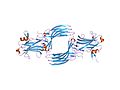 Arrestin structure from PDB 1G4M


