Asarum canadense: Difference between revisions
CSV import Tags: mobile edit mobile web edit |
CSV import |
||
| Line 27: | Line 27: | ||
{{Flora-stub}} | {{Flora-stub}} | ||
{{Medicine-stub}} | {{Medicine-stub}} | ||
<gallery> | |||
File:Asarum_canadense_-_Wild_Ginger.jpg|Asarum canadense - Wild Ginger | |||
File:Asarum_canadense.jpg|Asarum canadense | |||
File:Asarum_canadense_4.jpg|Asarum canadense | |||
</gallery> | |||
Latest revision as of 01:39, 18 February 2025
Asarum canadense, commonly known as Canadian wild ginger, is a perennial herbaceous plant native to the deciduous forests of North America. It belongs to the family Aristolochiaceae and is known for its distinctive heart-shaped leaves and small, brownish-red flowers.
Description[edit]
Asarum canadense is a low-growing plant, typically reaching heights of 10 to 30 cm. The leaves are broad and heart-shaped, with a smooth surface and a deep green color. The flowers, which bloom in the spring, are small and bell-shaped, with a brownish-red color. They are usually hidden beneath the leaves.
Distribution and Habitat[edit]
Asarum canadense is found throughout the eastern half of North America, from the southern regions of Canada to the northern parts of the United States. It prefers the moist, rich soils of deciduous forests, often growing in the shade of larger trees.
Uses[edit]
Historically, Asarum canadense has been used by Native American tribes for medicinal purposes. The root was often used to treat a variety of ailments, including digestive problems and respiratory conditions. However, due to the presence of the toxic compound aristolochic acid, it is no longer recommended for medicinal use.
Conservation Status[edit]
While Asarum canadense is not currently considered endangered, its population has been declining due to habitat loss and overharvesting for medicinal use. Conservation efforts are focused on protecting its natural habitat and regulating its harvest.
See Also[edit]
References[edit]
- Flora of North America
- Medicinal Plants of the American East

This flora-related article is a stub. You can help WikiMD by expanding it.

-
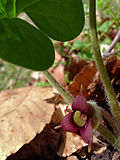 Asarum canadense - Wild Ginger
 -
 Asarum canadense
 -
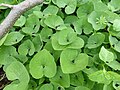 Asarum canadense


