Dialysis catheter: Difference between revisions
CSV import Tags: mobile edit mobile web edit |
CSV import |
||
| Line 24: | Line 24: | ||
[[Category:Nephrology]] | [[Category:Nephrology]] | ||
{{medicine-stub}} | {{medicine-stub}} | ||
<gallery> | |||
File:Catheter.png|Dialysis catheter | |||
File:Temporary_HemoDialysis_Catheter.jpg|Temporary hemodialysis catheter | |||
File:Permacath.jpg|Permacath | |||
</gallery> | |||
Latest revision as of 01:36, 18 February 2025
Dialysis Catheter
A dialysis catheter is a catheter used for exchanging blood to and from the hemodialysis machine from the patient. This process is essential for patients suffering from advanced chronic kidney disease (CKD) or acute kidney injury (AKI), where the kidneys are no longer able to filter waste products from the blood effectively. Dialysis catheters are a vital component in providing life-sustaining dialysis treatment for these patients.
Types of Dialysis Catheters[edit]
There are primarily two types of dialysis catheters: venous and arteriovenous fistula (AVF) catheters. Venous catheters are inserted into a large vein, typically in the neck, chest, or groin. These are often used for short-term access. On the other hand, arteriovenous fistula catheters are created surgically by connecting an artery to a vein, usually in the arm, and are intended for long-term use.
Tunneled Catheters[edit]
Tunneled dialysis catheters are placed under the skin to reduce the risk of infection. They have a cuff that promotes tissue growth to help secure the catheter in place and act as a barrier to bacteria.
Non-Tunneled Catheters[edit]
Non-tunneled catheters are typically used for emergency or short-term dialysis access. They are inserted directly into a vein without being tunneled under the skin and have a higher risk of infection compared to tunneled catheters.
Complications[edit]
The use of dialysis catheters can be associated with several complications. The most common include infection, thrombosis (blood clots), and catheter malfunction. Infections can be serious and lead to hospitalization. Thrombosis can reduce the efficiency of dialysis by blocking the flow of blood. Regular monitoring and care are essential to minimize these risks.
Care and Maintenance[edit]
Proper care and maintenance of the dialysis catheter are crucial to prevent complications. This includes regular cleaning of the catheter site, ensuring the catheter is securely in place, and monitoring for signs of infection or other problems. Healthcare providers will provide detailed instructions on catheter care to patients and caregivers.
Conclusion[edit]
Dialysis catheters play a critical role in the management of kidney failure, providing a lifeline for patients requiring hemodialysis. While they are associated with certain risks, careful selection, insertion, and maintenance can help minimize complications and ensure effective dialysis treatment.

-
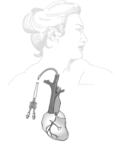 Dialysis catheter
 -
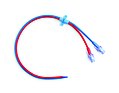 Temporary hemodialysis catheter
 -
Permacath


