Mathematical modelling of infectious diseases: Difference between revisions
CSV import |
CSV import |
||
| Line 37: | Line 37: | ||
[[Category:Infectious diseases]] | [[Category:Infectious diseases]] | ||
{{Epidemiology-stub}} | {{Epidemiology-stub}} | ||
<gallery> | |||
File:SIR-Modell.svg|SIR model diagram | |||
File:SIR_model_anim.gif|SIR model animation | |||
</gallery> | |||
Latest revision as of 01:33, 18 February 2025
Mathematical modelling of infectious diseases is a method used in epidemiology to understand the mechanisms by which diseases spread, predict the future course of an outbreak, and evaluate strategies to control an epidemic. These models are essential tools in predicting the spread of infectious diseases, assessing public health interventions, and understanding the underlying mechanisms of disease transmission.
Overview[edit]
Mathematical models can take many forms, including deterministic models, stochastic models, and agent-based models. These models use mathematical equations to represent the transmission of a disease in a population. The models are based on assumptions about the parameters that influence disease transmission, such as the infectious period, the contact rate, and the susceptibility of the population.
Types of Models[edit]
Deterministic Models[edit]
Deterministic models in epidemiology are those that always produce the same output from a given starting condition or initial state. The most common deterministic model is the SIR model, which divides the population into three groups: susceptible, infectious, and recovered.
Stochastic Models[edit]
Stochastic models incorporate randomness into the model, allowing for the possibility of different outcomes from the same initial conditions. These models are particularly useful when dealing with small populations, where random events can have a significant impact on disease transmission.
Agent-Based Models[edit]
Agent-based models simulate the actions and interactions of autonomous "agents" to assess their effects on the system as a whole. In the context of infectious disease modelling, agents can represent individuals or groups within a population, each with their own characteristics and behaviors.
Applications[edit]
Mathematical modelling of infectious diseases has been used to predict the spread of diseases such as influenza, HIV/AIDS, and COVID-19. These models have been instrumental in informing public health interventions, such as vaccination strategies and social distancing measures.
Limitations[edit]
While mathematical models can provide valuable insights into disease transmission, they are based on assumptions and simplifications that may not fully capture the complexities of real-world disease spread. Therefore, the results should be interpreted with caution and used as one of many tools in public health decision-making.
See Also[edit]
This epidemiology-related article is a stub. You can help WikiMD by expanding it.
-
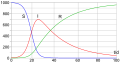 SIR model diagram
 -
 SIR model animation


