Anorexia mirabilis: Difference between revisions
CSV import |
CSV import |
||
| Line 26: | Line 26: | ||
[[Category:Medieval History]] | [[Category:Medieval History]] | ||
{{medicine-stub}} | {{medicine-stub}} | ||
<gallery> | |||
File:Domenico_Beccafumi_026.jpg|Anorexia mirabilis | |||
File:AngelaFoligno.jpg|Anorexia mirabilis | |||
File:Saint_Margaret_of_Corona.jpg|Anorexia mirabilis | |||
</gallery> | |||
Latest revision as of 01:32, 18 February 2025
Anorexia Mirabilis refers to a phenomenon primarily observed in the Middle Ages, where individuals, often women, would voluntarily refuse food and drink to the point of extreme fasting. This practice was not driven by a desire for physical thinness, as seen with anorexia nervosa, but rather for spiritual or religious reasons. Practitioners believed that by denying themselves earthly sustenance, they could achieve a closer connection to God, purify their souls, and express piety and devotion. This article delves into the historical context, notable figures, and the cultural significance of Anorexia Mirabilis.
Historical Context[edit]
The phenomenon of Anorexia Mirabilis is largely documented during the Middle Ages in Europe, a period marked by intense religious fervor and the valorization of asceticism. The practice was particularly prevalent among religious women, including saints and nuns, who viewed extreme fasting as a form of spiritual purification and a way to emulate the suffering of Christ. It was also seen as a method of resisting earthly desires and the temptations of the flesh, thereby demonstrating their devotion and sanctity.
Notable Figures[edit]
Several historical figures are associated with Anorexia Mirabilis, including:
- Catherine of Siena: A saint who is perhaps one of the most well-known practitioners of Anorexia Mirabilis. She is said to have subsisted on virtually nothing but the Holy Communion in the later years of her life.
- Angela of Foligno: Another saint who practiced extreme fasting as a form of religious devotion.
- Rose of Lima: Known for her extreme acts of asceticism, including fasting, as a way to achieve spiritual purity.
These individuals were often venerated for their extreme acts of self-denial, which were seen as evidence of their holiness and closeness to God.
Cultural Significance[edit]
Anorexia Mirabilis must be understood within the broader context of medieval Christian spirituality, which highly valued ascetic practices. Fasting, along with other forms of bodily mortification, was seen as a way to purify the soul, atone for sins, and achieve a mystical union with God. This practice also reflects the gender dynamics of the time, as women, in particular, were encouraged to suppress bodily desires as a means of demonstrating piety and virtue.
Modern Perspectives[edit]
In contemporary times, Anorexia Mirabilis is often studied in the context of the history of mental health and religious practices. While it shares similarities with anorexia nervosa, particularly in terms of self-starvation, the motivations behind Anorexia Mirabilis are distinct, rooted in spirituality rather than body image or psychological distress. However, some scholars argue that the phenomenon can offer insights into the complex interplay between religion, gender, and mental health.
Conclusion[edit]
Anorexia Mirabilis represents a fascinating intersection of religion, gender, and health in the Middle Ages. While it is a historical phenomenon, understanding it can provide valuable insights into the ways in which cultural and spiritual beliefs shape health behaviors and practices.

-
 Anorexia mirabilis
 -
 Anorexia mirabilis
 -
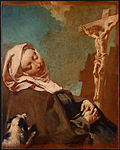 Anorexia mirabilis


