Farinograph: Difference between revisions
CSV import Tags: mobile edit mobile web edit |
CSV import |
||
| Line 22: | Line 22: | ||
[[Category:Rheology]] | [[Category:Rheology]] | ||
{{food-stub}} | {{food-stub}} | ||
<gallery> | |||
File:Farinograph_AT_2010.jpg|Farinograph | |||
File:Farinograph.jpg|Farinograph | |||
File:Farinograph2.jpg|Farinograph | |||
</gallery> | |||
Latest revision as of 01:31, 18 February 2025
Farinograph is a device used in the field of baking science and food technology to measure the rheological properties of flour. It is an essential tool for bakers, food scientists, and milling professionals to determine the suitability of a flour for a specific purpose.
History[edit]
The Farinograph was first developed in the early 20th century by the Brabender Company in Germany. It has since become a standard instrument in the baking and milling industries worldwide.
Function[edit]
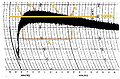
The Farinograph works by simulating the process of dough formation. A small sample of flour is mixed with water in a bowl, and the resistance of the dough to the mixing action is measured. This resistance, or viscosity, is plotted against time to create a curve known as the Farinograph curve. The characteristics of this curve provide valuable information about the flour's quality and performance.
Interpretation[edit]
Several parameters can be derived from the Farinograph curve, including water absorption, dough development time, dough stability, and degree of softening. These parameters are used to predict how the flour will behave during the baking process.
Applications[edit]
The Farinograph is used in various applications, including flour and dough testing, quality control, and product development. It helps bakers and food scientists to select the right type of flour for a particular product, adjust the water content in the dough, and optimize the mixing process.
See also[edit]

-
 Farinograph
 -
 Farinograph
 -
 Farinograph


