Traffic guard: Difference between revisions
CSV import |
CSV import |
||
| Line 51: | Line 51: | ||
[[Category:Traffic management]] | [[Category:Traffic management]] | ||
[[Category:Safety occupations]] | [[Category:Safety occupations]] | ||
<gallery> | |||
File:Traffic_signal_and_Security_guard_P5292395.jpg|Traffic guard directing traffic | |||
File:Flagger_on_M-124.JPG|Flagger on M-124 | |||
</gallery> | |||
Latest revision as of 01:30, 18 February 2025
Traffic Guard[edit]
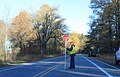
A traffic guard is a person responsible for directing vehicular and pedestrian traffic around a construction site, accident, or other road disruption, ensuring the safety of workers and the general public. Traffic guards are often employed during road construction projects, public events, or in areas where traffic flow needs to be managed temporarily.

Responsibilities[edit]
Traffic guards have several key responsibilities, including:
- Directing Traffic: Using hand signals, signs, or flags to guide vehicles and pedestrians safely around work zones or disruptions.
- Ensuring Safety: Monitoring the flow of traffic to prevent accidents and ensure the safety of workers and pedestrians.
- Communication: Coordinating with other traffic guards, construction workers, and law enforcement to manage traffic effectively.
- Setting Up and Removing Traffic Control Devices: Placing cones, barriers, and signs to direct traffic and removing them once the work is complete.
Equipment[edit]
Traffic guards typically use a variety of equipment to perform their duties, including:
- Flags and Signs: To signal drivers to stop, slow down, or proceed.
- Reflective Clothing: High-visibility vests or jackets to ensure they are seen by drivers.
- Radios: For communication with other traffic personnel and emergency services.

Training and Certification[edit]
Traffic guards often undergo specific training to learn the skills necessary for their role. This training may include:
- Traffic Control Techniques: Learning how to safely direct traffic and use control devices.
- Safety Protocols: Understanding safety measures to protect themselves and others.
- Emergency Procedures: Knowing how to respond in case of an accident or emergency.
In some regions, traffic guards must be certified or licensed, which may require passing a written exam or completing a training course.
Related Pages[edit]

References[edit]
- "Traffic Control Person Training Manual." [Online]. Available: [1](https://www.example.com/traffic-control-manual).
- "Safety Guidelines for Traffic Guards." [Online]. Available: [2](https://www.example.com/safety-guidelines).
-
 Traffic guard directing traffic
 -
 Flagger on M-124
