Uncontrolled decompression: Difference between revisions
From WikiMD's Wellness Encyclopedia
CSV import |
CSV import |
||
| Line 54: | Line 54: | ||
[[Category:Aviation safety]] | [[Category:Aviation safety]] | ||
[[Category:Spaceflight safety]] | [[Category:Spaceflight safety]] | ||
<gallery> | |||
File:Explosive_Decompression_Test_System.gif|Explosive Decompression Test System | |||
File:US_Navy_091006-N-9001B-017_Hospital_Corpsmen_2nd_Class_Kyle_Carswell_and_Daniel_Young_monitor_members_of_the_2009_class_of_NASA_astronaut_candidates_for_hypoxia_in_an_altitude_chamber.jpg|Hospital Corpsmen monitor NASA astronaut candidates for hypoxia in an altitude chamber | |||
</gallery> | |||
Latest revision as of 01:28, 18 February 2025
Uncontrolled Decompression[edit]

Uncontrolled decompression refers to the sudden and unplanned loss of pressure in a sealed environment, such as an aircraft cabin or a spacecraft. This phenomenon can occur due to structural failure, impact, or other breaches in the integrity of the pressure vessel.
Causes[edit]
Uncontrolled decompression can be caused by several factors, including:
- Structural failure: This can occur due to material fatigue, manufacturing defects, or damage from external forces.
- Impact: Collisions with other objects, such as birds or debris, can puncture the hull of an aircraft or spacecraft.
- Explosive devices: Intentional or accidental detonation of explosives can lead to rapid decompression.
Effects[edit]
The effects of uncontrolled decompression can be severe and include:
- Hypoxia: The rapid loss of pressure can lead to a decrease in available oxygen, causing hypoxia in occupants.
- Temperature drop: The sudden expansion of air can lead to a significant drop in temperature.
- Physical damage: The force of the decompression can cause structural damage to the vessel and harm to occupants.
Safety Measures[edit]
To mitigate the risks associated with uncontrolled decompression, several safety measures are implemented:
- Pressure suits: In spacecraft, astronauts wear pressure suits to protect against decompression.
- Oxygen masks: Aircraft are equipped with oxygen masks that deploy automatically in the event of decompression.
- Structural integrity testing: Regular maintenance and testing of the vessel's structure help prevent decompression incidents.
Historical Incidents[edit]
Several notable incidents of uncontrolled decompression have occurred, including:
- Helios Airways Flight 522: In 2005, a gradual decompression led to the incapacitation of the crew and passengers, resulting in a crash.
- United Airlines Flight 811: In 1989, a cargo door failure caused explosive decompression, leading to the loss of nine passengers.
Related Pages[edit]
References[edit]
- "Aviation Safety: The Basics of Decompression." Aviation Safety Network. Retrieved from [1]
- "NASA's Approach to Decompression Safety." NASA. Retrieved from [2]

| Aviation safety | ||||||||||
|---|---|---|---|---|---|---|---|---|---|---|
This aviation safety related article is a stub.
|
-
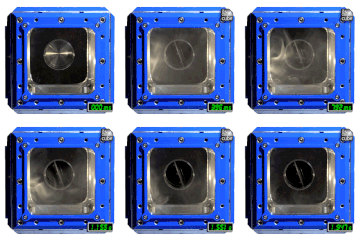 Explosive Decompression Test System
 -
 Hospital Corpsmen monitor NASA astronaut candidates for hypoxia in an altitude chamber
