Congenital trigger thumb: Difference between revisions
CSV import |
CSV import |
||
| Line 25: | Line 25: | ||
[[Category:Hand surgery]] | [[Category:Hand surgery]] | ||
{{medicine-stub}} | {{medicine-stub}} | ||
== Congenital_trigger_thumb == | |||
<gallery> | |||
File:Autosomal_dominant_-_en.svg|Diagram showing autosomal dominant inheritance pattern | |||
File:Notta_Nodule.jpg|Image of Notta's nodule on a thumb | |||
File:A1_Pulley_release.jpg|Surgical release of the A1 pulley in the thumb | |||
</gallery> | |||
Revision as of 01:22, 18 February 2025
Congenital Trigger Thumb
Congenital trigger thumb, also known as pediatric trigger thumb, is a condition present at birth where the thumb is fixed in a bent position and cannot be fully extended. This condition occurs due to the constriction or thickening of the flexor pollicis longus tendon, which is responsible for bending the thumb. It is a relatively rare disorder, affecting approximately 1 in 4,000 live births. The exact cause of congenital trigger thumb remains unknown, but it is not typically associated with any other congenital abnormalities.
Symptoms and Diagnosis
The most noticeable symptom of congenital trigger thumb is the inability of the affected child to straighten the thumb at the interphalangeal joint, leading to a flexed posture of the thumb. In some cases, a nodule can be felt at the base of the thumb, which is the thickened part of the tendon. Diagnosis is primarily clinical, based on physical examination. Imaging tests are rarely necessary unless there is a need to rule out other conditions.
Treatment
Treatment options for congenital trigger thumb vary depending on the severity of the condition and the age of the child. In infants and young children, spontaneous resolution is possible and often observed. However, if the condition persists beyond the age of 1 or becomes symptomatic, intervention may be required.
Non-Surgical Treatment
Initial treatment often involves conservative measures such as splinting or physical therapy. These methods aim to reduce the tendon's inflammation and improve thumb movement. However, the effectiveness of non-surgical treatments is limited, and they are generally considered when waiting for potential spontaneous resolution.
Surgical Treatment
Surgical intervention is recommended when conservative treatments fail or the condition is severe. The surgery, known as a trigger thumb release, involves making a small incision at the base of the thumb to release the constricted section of the tendon. This procedure is highly effective and usually results in full recovery of thumb movement.
Prognosis
The prognosis for children with congenital trigger thumb is excellent, especially when treated appropriately. Most children regain full function of their thumb after surgery with minimal risk of recurrence. Early detection and treatment are crucial to prevent potential complications, such as permanent stiffness or deformity of the thumb.
Prevention
Since the exact cause of congenital trigger thumb is unknown, there are no specific preventive measures. However, early detection and treatment can prevent complications and ensure a better outcome for the affected child.

Congenital_trigger_thumb
-
 Diagram showing autosomal dominant inheritance pattern
 -
 Image of Notta's nodule on a thumb
 -
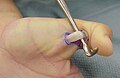 Surgical release of the A1 pulley in the thumb


