Vapor barrier: Difference between revisions
CSV import |
CSV import |
||
| Line 38: | Line 38: | ||
[[Category:Building materials]] | [[Category:Building materials]] | ||
[[Category:Moisture control]] | [[Category:Moisture control]] | ||
<gallery> | |||
File:Vapour_barrier.JPG|Vapor barrier installation | |||
File:Fs195_cp25_fibreglass_pc.jpg|Fibreglass insulation with vapor barrier | |||
File:Vapor_barrier_replace.jpg|Replacing a vapor barrier | |||
</gallery> | |||
Latest revision as of 01:21, 18 February 2025
Vapor Barrier[edit]
A vapor barrier is a material used in building construction to resist moisture diffusion through walls, ceilings, and floors. The primary purpose of a vapor barrier is to prevent moisture from entering the building envelope, which can lead to mold growth, structural damage, and reduced insulation effectiveness.

Function[edit]
Vapor barriers are designed to limit the movement of water vapor through the building envelope. They are typically installed on the warm side of the insulation in a building, which is the side closest to the interior of the building in cold climates. This placement helps to prevent condensation from forming within the wall cavity, which can occur when warm, moist air from the interior meets the cooler air within the wall.
Materials[edit]
Common materials used for vapor barriers include polyethylene plastic sheeting, aluminum foil, and specialized vapor-retardant paints. The choice of material depends on the specific requirements of the building project, including climate, building design, and local building codes.

Installation[edit]
Proper installation of a vapor barrier is crucial to its effectiveness. It must be continuous and free of gaps or tears. Seams should be overlapped and sealed with appropriate tape or sealant. In some cases, vapor barriers are integrated into other building materials, such as insulation batts with a vapor-retardant facing.
Considerations[edit]
The use of vapor barriers is not always necessary or beneficial in all climates. In some warm, humid climates, vapor barriers can trap moisture within the building envelope, leading to problems rather than preventing them. It is important to consider the specific climate and building conditions when deciding whether to use a vapor barrier.
Related Pages[edit]
References[edit]
- "Vapor Barriers: A Guide to Understanding Moisture Control." Building Science Corporation. Retrieved from [1].
- "Moisture Control Handbook: Principles and Practices for Residential and Small Commercial Buildings." John Wiley & Sons.

-
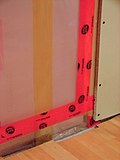 Vapor barrier installation
 -
 Fibreglass insulation with vapor barrier
 -
 Replacing a vapor barrier
