Manjar blanco: Difference between revisions
CSV import |
CSV import |
||
| Line 46: | Line 46: | ||
[[Category:Condiments]] | [[Category:Condiments]] | ||
[[Category:Sweet foods]] | [[Category:Sweet foods]] | ||
<gallery> | |||
File:Menjablanc_de_Reus.jpg|Traditional Menjablanc de Reus | |||
File:Menjablanc_de_Reus_(8).jpg|Close-up of Menjablanc de Reus | |||
File:Bowl_of_"Manjar_Blanco".JPG|Bowl of Manjar Blanco | |||
</gallery> | |||
Latest revision as of 01:21, 18 February 2025
Manjar Blanco[edit]
| [[File:|frameless|alt=]] | |
| Alternative names | |
| Type | |
| Course | Dessert |
| Place of origin | Peru |
| Region or state | |
| Associated national cuisine | |
| Created by | |
| Invented | |
| Cooking time | minutes to minutes |
| Serving temperature | |
| Main ingredients | Milk, sugar, vanilla |
| Ingredients generally used | |
| Variations | |
| Food energy | kcal |
| Nutritional value | Protein: g, Fat: g, Carbohydrate: g |
| Glycemic index | |
| Similar dishes | |
| Other information | |
| Website | [ Official website] |
Manjar Blanco is a traditional Peruvian dessert that is popular throughout the country. It is a sweet, creamy treat made from simple ingredients such as milk, sugar, and vanilla. This article will provide a detailed overview of Manjar Blanco, including its history, preparation, and variations.
History[edit]
The origins of Manjar Blanco can be traced back to colonial times in Peru. It is believed to have been influenced by Spanish cuisine, particularly the traditional Spanish dessert known as "dulce de leche." Over the years, Manjar Blanco has become an integral part of Peruvian culinary culture and is often enjoyed during special occasions and celebrations.
Preparation[edit]
To make Manjar Blanco, a combination of milk, sugar, and vanilla is slowly cooked until it thickens and reaches a creamy consistency. The process involves simmering the ingredients over low heat while continuously stirring to prevent burning. This slow cooking method allows the flavors to develop and creates a smooth, velvety texture.
Variations[edit]
While the basic recipe for Manjar Blanco remains the same, there are variations that incorporate additional ingredients or flavors. Some variations include the addition of cinnamon, nutmeg, or citrus zest to enhance the taste. Others may use condensed milk or evaporated milk for a richer and sweeter flavor.
Serving and Consumption[edit]
Manjar Blanco is typically served as a dessert or used as a filling for pastries and cakes. It can be enjoyed on its own, spread on bread or crackers, or used as a topping for ice cream. In Peru, it is commonly used as a filling for traditional desserts like alfajores and turrón.
See Also[edit]
References[edit]
<references group="" responsive="1"></references>
-
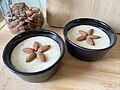 Traditional Menjablanc de Reus
 -
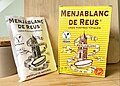 Close-up of Menjablanc de Reus
 -
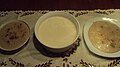 Bowl of Manjar Blanco

.jpg)

