Gray asexuality: Difference between revisions
CSV import |
CSV import |
||
| Line 23: | Line 23: | ||
[[Category:Asexuality]] | [[Category:Asexuality]] | ||
{{Sexuality-stub}} | {{Sexuality-stub}} | ||
<gallery> | |||
File:A_spec_compass.svg|A-spec Compass | |||
File:Grey_asexuality_flag.svg|Grey Asexuality Flag | |||
File:Demisexual_Pride_Flag.svg|Demisexual Pride Flag | |||
</gallery> | |||
Latest revision as of 01:16, 18 February 2025
Gray asexuality or gray-sexuality (spelled grey outside the U.S.) is a spectrum of sexual orientation that is characterized by limited or occasional sexual attraction or desire. This spectrum includes individuals who identify as asexual, demisexual, and semi-sexual, among others.
Definition[edit]
Gray asexuality is often defined as the area between asexuality and sexuality, in which a person may only experience sexual attraction on rare occasions. The frequency, intensity, or quality of these attractions may vary. Some gray-asexual people may feel sexual attraction but have a low sex drive, while others may have a high sex drive but experience sexual attraction infrequently.
Demographics[edit]
While there is limited research on the prevalence of gray asexuality, it is estimated that about 1% of the population identifies as asexual, with a smaller percentage identifying specifically as gray-asexual. Gray asexuality is not limited to any specific gender or age group.
Recognition and Community[edit]
Gray asexuality is recognized by the American Psychological Association (APA) and is included in the Asexual Visibility and Education Network (AVEN). AVEN hosts forums for gray-asexual individuals to share their experiences and provides resources for understanding this orientation.
See Also[edit]
.svg)
-
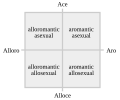 A-spec Compass
 -
 Grey Asexuality Flag
 -
 Demisexual Pride Flag


