Aniridia: Difference between revisions
CSV import Tags: mobile edit mobile web edit |
CSV import |
||
| Line 28: | Line 28: | ||
{{Medicine-stub}} | {{Medicine-stub}} | ||
== Aniridia == | |||
<gallery> | |||
File:Aniridia.jpg|Aniridia | |||
File:Human_eyeball_with_phenotypic_expression_of_aniridia_with_PAX6_gene_mutation.jpg|Human eyeball with phenotypic expression of aniridia with PAX6 gene mutation | |||
</gallery> | |||
Revision as of 01:14, 18 February 2025
Aniridia is a rare genetic disorder characterized by the underdevelopment or absence of the iris in the eye. This condition, which affects both eyes in the majority of cases, leads to a reduction in the eye's ability to control the amount of light entering the eye, resulting in vision problems and sensitivity to light (photophobia). Aniridia is not merely an isolated eye condition but is often associated with various other ocular and systemic abnormalities.
Etiology
Aniridia is primarily caused by mutations in the PAX6 gene, located on chromosome 11p13. The PAX6 gene plays a crucial role in the development of the eyes and other parts of the body. Mutations in this gene disrupt the normal development of the iris and can affect other structures of the eye. Aniridia can be inherited in an autosomal dominant pattern, meaning a single copy of the altered gene in each cell is sufficient to cause the disorder. However, there are cases where the condition occurs due to a new mutation in the gene and is not inherited from a parent.
Clinical Features
The hallmark feature of aniridia is the partial or complete absence of the iris. This leads to a host of visual impairments including decreased visual acuity, nystagmus (involuntary eye movements), and photophobia. Additionally, individuals with aniridia may experience a range of other ocular complications such as cataracts, glaucoma, and keratopathy. Aniridia can also be part of a syndrome, most notably WAGR syndrome (Wilms tumor, Aniridia, Genitourinary anomalies, and mental Retardation syndrome), which involves a deletion on chromosome 11 including the PAX6 and WT1 genes.
Diagnosis
Diagnosis of aniridia is primarily based on clinical examination of the eye. Genetic testing can confirm the diagnosis by identifying mutations in the PAX6 gene. Imaging studies and thorough eye examinations are essential to assess the extent of the condition and associated ocular complications.
Management
There is no cure for aniridia, but the condition and its associated complications can be managed with a multidisciplinary approach. Management strategies may include the use of corrective lenses, sunglasses or photochromic lenses to manage light sensitivity, and surgical interventions for cataracts, glaucoma, and other ocular abnormalities. Regular monitoring and early intervention for ocular complications are crucial to preserve vision.
Prognosis
The prognosis for individuals with aniridia varies depending on the presence and severity of associated ocular and systemic conditions. With appropriate management, individuals with aniridia can lead productive lives, although they may experience limitations due to visual impairment.
See Also

Aniridia
-
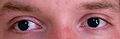 Aniridia
 -
 Human eyeball with phenotypic expression of aniridia with PAX6 gene mutation


