Vascular anomaly: Difference between revisions
CSV import |
CSV import |
||
| Line 50: | Line 50: | ||
[[Category:Vascular diseases]] | [[Category:Vascular diseases]] | ||
[[Category:Congenital disorders]] | [[Category:Congenital disorders]] | ||
<gallery> | |||
File:Pyogenic_Granuloma_Thumb_1.JPG|Pyogenic Granuloma on Thumb | |||
File:Myhand.jpg|Vascular anomaly on hand | |||
File:Lymphangioma.jpg|Lymphangioma | |||
</gallery> | |||
Revision as of 01:08, 18 February 2025
A group of disorders involving abnormal blood vessels or lymph vessels
Vascular anomaly refers to a group of disorders characterized by abnormal development of blood vessels or lymphatic vessels. These anomalies can be broadly classified into vascular tumors and vascular malformations. They can occur anywhere in the body and vary widely in their clinical presentation, prognosis, and treatment.
Classification
Vascular anomalies are generally classified into two main categories:
Vascular Tumors
Vascular tumors are characterized by increased endothelial cell turnover. The most common type is the hemangioma, which typically appears shortly after birth, grows rapidly, and then involutes over time. Other types include pyogenic granuloma and Kaposiform hemangioendothelioma.
Vascular Malformations
Vascular malformations are present at birth and grow proportionately with the child. They are further classified based on the type of vessel involved:
- Capillary malformations: Commonly known as port-wine stains.
- Venous malformations: Abnormal veins that can cause pain and swelling.
- Lymphatic malformations: Abnormal lymph vessels, which can lead to swelling and fluid accumulation.
- Arteriovenous malformations: Abnormal connections between arteries and veins, which can lead to bleeding and other complications.
Diagnosis
Diagnosis of vascular anomalies typically involves a combination of clinical examination, imaging studies such as ultrasound, MRI, and sometimes biopsy. The specific type of anomaly often dictates the diagnostic approach.
Treatment
Treatment varies depending on the type and severity of the vascular anomaly. Options include:
- Observation: Many hemangiomas resolve spontaneously without intervention.
- Medical therapy: Medications such as propranolol are used for certain hemangiomas.
- Sclerotherapy: Injection of a sclerosing agent to shrink the malformation.
- Surgery: Reserved for cases where other treatments are ineffective or when the anomaly causes significant symptoms.
Prognosis
The prognosis for individuals with vascular anomalies depends on the type and location of the anomaly. Many hemangiomas resolve without treatment, while some malformations may require ongoing management.
Related pages
Gallery
-
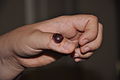 Pyogenic granuloma on the thumb
 -
 Example of a vascular anomaly on the hand
 -
 Lymphangioma


References
- Mulliken, J. B., & Glowacki, J. (1982). Hemangiomas and vascular malformations in infants and children: a classification based on endothelial characteristics. Plastic and Reconstructive Surgery, 69(3), 412-422.
- Enjolras, O., & Mulliken, J. B. (1997). Vascular tumors and vascular malformations (new issues). Advances in Dermatology, 13, 375-423.
-
Pyogenic Granuloma on Thumb
-
Vascular anomaly on hand
-
Lymphangioma
