Neurosarcoidosis: Difference between revisions
CSV import |
CSV import Tags: mobile edit mobile web edit |
||
| Line 23: | Line 23: | ||
[[Category:Ailments of unknown cause]] | [[Category:Ailments of unknown cause]] | ||
{{dictionary-stub1}} | {{dictionary-stub1}} | ||
<gallery> | |||
File:Blausen_0284_CranialNerves.png|Diagram of Cranial Nerves | |||
File:Neurosarcoidosis_MRI_pre-post_treatment_arrows.gif|Neurosarcoidosis MRI pre and post treatment | |||
</gallery> | |||
Revision as of 01:06, 18 February 2025
Neurosarcoidosis is a manifestation of sarcoidosis, a disease of unknown cause characterized by the formation of immune system cells into clumps known as granulomas. When these granulomas form in the nervous system, the condition is referred to as neurosarcoidosis.
Symptoms
The symptoms of neurosarcoidosis are diverse and depend on the area of the nervous system affected. They may include headache, seizures, weakness, numbness, dizziness, vertigo, visual disturbances, and behavioral changes.
Diagnosis
Diagnosis of neurosarcoidosis is challenging due to the wide range of symptoms and the lack of a specific diagnostic test. It is often a diagnosis of exclusion, meaning other potential causes of the symptoms must be ruled out first. Diagnostic tests may include MRI, lumbar puncture, and biopsy of affected tissue.
Treatment
Treatment of neurosarcoidosis typically involves medications to suppress the immune system and reduce inflammation, such as corticosteroids. Other treatments may be used depending on the specific symptoms and their severity.
Prognosis
The prognosis for neurosarcoidosis varies widely. Some people may experience mild symptoms and require minimal treatment, while others may have severe symptoms that are difficult to manage. The disease can be chronic and progressive, but in some cases, it may go into remission.
See also
 | |
|---|---|
 |
 |
| Sarcoidosis |
|---|
|
|
-
 Diagram of Cranial Nerves
 -
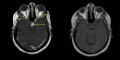 Neurosarcoidosis MRI pre and post treatment


