Long Depression: Difference between revisions
CSV import Tags: mobile edit mobile web edit |
CSV import Tags: mobile edit mobile web edit |
||
| Line 30: | Line 30: | ||
[[Category:Financial crises]] | [[Category:Financial crises]] | ||
{{Economic history-stub}} | {{Economic history-stub}} | ||
<gallery> | |||
File:Panic_of_1873_bank_run.jpg|Bank run during the Panic of 1873 | |||
File:US-GNP-per-capita-1869-1918.png|US GNP per capita from 1869 to 1918 | |||
</gallery> | |||
Latest revision as of 00:58, 18 February 2025
Long Depression
The Long Depression was a worldwide economic recession that began in 1873 and lasted until 1896. It was the most severe in Europe and the United States, which had been experiencing strong economic growth fueled by the Second Industrial Revolution and the end of the Civil War. The depression was characterized by a drop in commodity prices, a decline in trade and manufacturing, and a series of banking crises.
Causes[edit]
The causes of the Long Depression are still debated by economic historians. Some argue that it was triggered by the Panic of 1873, a financial crisis that began with the collapse of the Vienna Stock Exchange and quickly spread to the rest of Europe and North America. Others point to the end of the post-Civil War economic boom in the United States and the overexpansion of the railroad industry.
Effects[edit]
The Long Depression had profound effects on societies around the world. In the United States, it led to the rise of the Populist Movement, which sought to address the economic hardships faced by farmers and workers. In Europe, it contributed to the rise of socialist and labor movements.
Recovery[edit]
Recovery from the Long Depression was slow and uneven. In the United States, it was not until the Klondike Gold Rush in 1896 that the economy began to recover. In Europe, recovery was slower, with some countries not fully recovering until the early 20th century.
See also[edit]
References[edit]
<references />
This economic history related article is a stub. You can help WikiMD by expanding it.
-
 Bank run during the Panic of 1873
 -
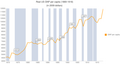 US GNP per capita from 1869 to 1918


