Buxus sempervirens: Difference between revisions
CSV import |
CSV import |
||
| Line 28: | Line 28: | ||
[[Category:Buxaceae]] | [[Category:Buxaceae]] | ||
{{Flora-stub}} | {{Flora-stub}} | ||
<gallery> | |||
File:Buxus_sempervirens.jpg|Buxus sempervirens | |||
File:AldenBiesen02.jpg|Alden Biesen | |||
File:Flute_(AM_1998.60.183-3).jpg|Flute (AM 1998.60.183-3) | |||
File:Cardiac_vessels.png|Cardiac vessels | |||
</gallery> | |||
Revision as of 00:56, 18 February 2025
Buxus sempervirens, commonly known as Boxwood or European box, is a species of flowering plant in the family Buxaceae, native to western and southern Europe, northwest Africa, and southwest Asia.
Description
Buxus sempervirens is an evergreen shrub or small tree growing to 1–9 m (3.3–29.5 ft) tall, with a dense mass of small, rounded to lance-shaped, glossy dark green leaves. The flowers are small and yellow-green, monoecious with both sexes present on a plant. The fruit is a small capsule containing several small black seeds.
Distribution and habitat
Buxus sempervirens is native to western and southern Europe, northwest Africa, and southwest Asia. It is found in a variety of habitats, including woodland, scrub, and rocky areas. It is often associated with calcareous soils.
Cultivation and uses
Buxus sempervirens is widely cultivated as an ornamental plant for use in landscaping and gardens. It is particularly valued for its use in formal gardens, where it is often used to create hedges, topiary, or other structured forms. It is also used in bonsai.
The wood of Buxus sempervirens is very hard and dense, making it highly valued for a variety of uses. It has been used for making musical instruments, engraving blocks, and precision instruments.
Conservation
While Buxus sempervirens is not currently considered threatened, it is subject to a number of threats, including habitat loss and the spread of diseases such as box blight.
See also
References
<references />

This flora-related article is a stub. You can help WikiMD by expanding it.
-
 Buxus sempervirens
 -
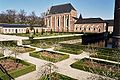 Alden Biesen
 -
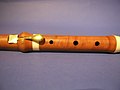 Flute (AM 1998.60.183-3)
 -
 Cardiac vessels


.jpg)

