DSV Turtle: Difference between revisions
CSV import |
CSV import |
||
| Line 20: | Line 20: | ||
[[Category:1968 ships]] | [[Category:1968 ships]] | ||
{{US-navy-stub}} | {{US-navy-stub}} | ||
<gallery> | |||
File:DSV_Turtle.jpg|DSV Turtle | |||
File:Turtle_DSV-3.jpg|Turtle DSV-3 | |||
File:Commisioning_of_AUTEC_1_and_AUTEC_2.jpg|Commissioning of AUTEC 1 and AUTEC 2 | |||
File:Mirchi_ka_salan_and_Dahi_chutney.jpg|Mirchi ka salan and Dahi chutney | |||
</gallery> | |||
Revision as of 00:55, 18 February 2025
DSV Turtle is a deep-submergence vehicle (DSV) that was developed and operated by the United States Navy. Named after the American Revolutionary War submarine Turtle, DSV Turtle was commissioned in 1968 and decommissioned in 1998.
Design and Capabilities
DSV Turtle was designed to perform deep-sea rescue operations and underwater research missions. It was capable of diving to depths of up to 10,000 feet (3,048 meters). The vehicle was equipped with a manipulator arm for handling objects and conducting underwater tasks. It also had a sonar system for navigation and object detection.
Operational History
During its 30 years of service, DSV Turtle participated in numerous missions. One of its most notable missions was the recovery of the F-14 Tomcat jet that crashed into the sea in 1979. The vehicle was also used in the search for the sunken submarine USS Scorpion.
Legacy
DSV Turtle's contributions to deep-sea exploration and rescue operations have been recognized by the United States Navy. The vehicle is now on display at the Naval Undersea Museum in Keyport, Washington.
See Also

-
DSV Turtle
-
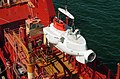 Turtle DSV-3
 -
 Commissioning of AUTEC 1 and AUTEC 2
 -
 Mirchi ka salan and Dahi chutney


