Corneal limbus: Difference between revisions
CSV import Tags: mobile edit mobile web edit |
CSV import |
||
| Line 26: | Line 26: | ||
[[Category:Eye anatomy]] | [[Category:Eye anatomy]] | ||
{{medicine-stub}} | {{medicine-stub}} | ||
== Corneal_limbus == | |||
<gallery> | |||
File:Limbus.png|Corneal limbus | |||
File:Human_eye_with_limbal_ring,_anterior_view.jpg|Human eye with limbal ring, anterior view | |||
</gallery> | |||
Latest revision as of 00:52, 18 February 2025
Corneal limbus is the border area or junction between the cornea and the sclera (the white of the eye) in the human eye. This region is rich in stem cells and plays a crucial role in the regeneration of corneal epithelium. Understanding the anatomy and function of the corneal limbus is essential in the field of ophthalmology, especially in the treatment of eye diseases and injuries.
Anatomy[edit]
The corneal limbus is approximately 1.0 to 1.5 mm in width and encircles the cornea. It is a transitional zone that contains a high density of melanocytes, giving it a slightly darker appearance than the adjacent sclera and cornea. The limbus demarcates the clear cornea from the opaque sclera and is involved in maintaining the proper curvature and structural integrity of the cornea.
Function[edit]
The primary function of the corneal limbus is to serve as a niche for corneal epithelial stem cells, also known as limbal stem cells (LSCs). These stem cells are vital for the continuous renewal and repair of the corneal surface. They help maintain corneal transparency and vision by regenerating the corneal epithelium, which is the outermost layer of the cornea.
In addition to housing stem cells, the limbus plays a role in the ocular immune response. It contains a high concentration of antigen-presenting cells, contributing to the eye's defense against pathogens.
Clinical Significance[edit]
Damage or dysfunction of the limbal stem cells can lead to a condition known as limbal stem cell deficiency (LSCD). LSCD can result from various causes, including chemical burns, genetic diseases, contact lens wear, and chronic inflammation. It is characterized by the invasion of conjunctival cells onto the corneal surface, leading to corneal opacity, neovascularization, chronic inflammation, and loss of vision.
Treatment options for LSCD aim to restore the limbal stem cell population. These can include limbal stem cell transplantation, either from the patient's unaffected eye or from a donor. Advances in tissue engineering and cell therapy are also exploring the use of cultured limbal stem cells for transplantation.
Research and Future Directions[edit]
Research in the field of corneal limbus and limbal stem cells is ongoing, with the goal of improving the understanding and treatment of corneal diseases. Innovations in gene therapy, stem cell therapy, and tissue engineering hold promise for more effective treatments for LSCD and other corneal conditions.
See Also[edit]

Corneal_limbus[edit]
-
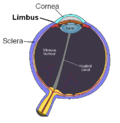 Corneal limbus
 -
Human eye with limbal ring, anterior view


