Conopodium majus: Difference between revisions
CSV import |
CSV import |
||
| Line 19: | Line 19: | ||
[[Category:Apiaceae]] | [[Category:Apiaceae]] | ||
{{food-stub}} | {{food-stub}} | ||
<gallery> | |||
File:Illustration_Conopodium_majus_British_Flora.jpg|Illustration of Conopodium majus from British Flora | |||
File:Pignut_at_Kilmaurs.JPG|Pignut at Kilmaurs | |||
</gallery> | |||
Latest revision as of 00:47, 18 February 2025
Conopodium majus, commonly known as pignut or earthnut, is a perennial plant belonging to the family Apiaceae. It is native to temperate regions of Europe and has been found in parts of Asia. The plant is notable for its edible underground tuber, which has been consumed by humans for centuries.
Description[edit]
Conopodium majus grows to a height of 30-60 cm. It has a slender, hollow stem and feathery leaves that are divided into smaller leaflets. The plant produces small, white flowers arranged in umbels, typical of the Apiaceae family. Flowering occurs from May to June. The most distinctive feature of Conopodium majus is its underground tuber, which is small, rounded, and has a nutty flavor when cooked.
Habitat and Distribution[edit]
Conopodium majus prefers well-drained soils in woodlands, grasslands, and hedgerows. It is widely distributed across Europe, from the Mediterranean to Scandinavia, and eastwards to the Caucasus. The plant's preference for undisturbed habitats means it is often found in areas that have not been subjected to intensive agricultural practices.
Culinary Uses[edit]
The tuber of Conopodium majus is the part most commonly consumed. It can be eaten raw or cooked and has a sweet, nutty flavor reminiscent of chestnuts. Historically, pignuts were foraged as a food source, but they are not widely cultivated for commercial purposes. Foragers must be careful to correctly identify Conopodium majus as its tubers can be confused with those of poisonous plants.
Conservation Status[edit]
While Conopodium majus is not currently listed as endangered, its habitats are threatened by agricultural expansion, deforestation, and urbanization. Conservation efforts are important to ensure the survival of this species and its ecosystem.
Cultural Significance[edit]
In folklore, pignuts were believed to be used by witches and were associated with various superstitions. They have also been mentioned in literature, reflecting their place in the cultural heritage of regions where they are found.

-
 Illustration of Conopodium majus from British Flora
 -
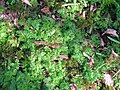 Pignut at Kilmaurs


