Lycopus europaeus: Difference between revisions
CSV import |
CSV import |
||
| Line 29: | Line 29: | ||
[[Category:Medicinal plants]] | [[Category:Medicinal plants]] | ||
{{Flora-stub}} | {{Flora-stub}} | ||
<gallery> | |||
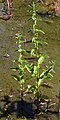
File:Wolfspoot_R0012816.JPG|Lycopus europaeus plant in natural habitat | |||
File:Lycopus_europaeus_Prague_2012_3.jpg|Close-up of Lycopus europaeus leaves | |||
</gallery> | |||
Latest revision as of 00:46, 18 February 2025
Lycopus europaeus, commonly known as Gypsywort, Bugleweed, or European Water Horehound, is a perennial herbaceous plant in the Lamiaceae family. It is native to Europe and Asia but has been introduced to North America and is now found in many parts of the continent.
Description[edit]
Lycopus europaeus is a robust plant that can reach up to 1 meter in height. It has square stems and opposite leaves. The leaves are lanceolate to ovate, with serrated margins. The flowers are small, white, and arranged in whorls in the axils of the leaves. The plant blooms from June to September.
Habitat and Distribution[edit]
Lycopus europaeus is found in a variety of habitats, including wetlands, marshes, and along the banks of rivers and streams. It prefers moist, nutrient-rich soils. In Europe, it is widespread and can be found from Scandinavia in the north to the Mediterranean in the south. In Asia, it is found in temperate regions, including China and Japan. In North America, it is considered an invasive species in some areas.
Uses[edit]
Lycopus europaeus has been used in traditional medicine for its sedative and astringent properties. It has also been used to treat thyroid disorders. However, the scientific evidence supporting these uses is limited.
Cultivation[edit]
Lycopus europaeus is not commonly cultivated, but it can be grown from seed or by division of the roots. It prefers a sunny or partially shaded location and moist soil.
Conservation Status[edit]
Lycopus europaeus is not considered threatened or endangered. However, like all wild plants, it is protected under the Convention on International Trade in Endangered Species of Wild Fauna and Flora (CITES).
See Also[edit]
References[edit]
<references />

This flora-related article is a stub. You can help WikiMD by expanding it.
-
 Lycopus europaeus plant in natural habitat
 -
 Close-up of Lycopus europaeus leaves


