AMP-activated protein kinase: Difference between revisions
CSV import |
CSV import |
||
| Line 37: | Line 37: | ||
File:Active_AMPK.png|Active AMPK | File:Active_AMPK.png|Active AMPK | ||
File:Active_and_Inactive_AMPK.tif|Active and Inactive AMPK | File:Active_and_Inactive_AMPK.tif|Active and Inactive AMPK | ||
</gallery> | |||
<gallery> | |||
File:Active_AMPK.png|AMP-activated protein kinase | |||
File:Active_and_Inactive_AMPK.tif|AMP-activated protein kinase | |||
</gallery> | </gallery> | ||
Latest revision as of 00:45, 18 February 2025
AMP-activated protein kinase


AMP-activated protein kinase (AMPK) is an enzyme that plays a crucial role in cellular energy homeostasis. It is a serine/threonine kinase that is activated in response to an increase in the AMP/ATP ratio, which occurs during cellular stress and low energy states.
Structure[edit]
AMPK is a heterotrimeric complex composed of three subunits: the catalytic _ subunit, and the regulatory _ and _ subunits. The _ subunit contains the kinase domain, while the _ subunit acts as a scaffold, and the _ subunit contains binding sites for AMP, ADP, and ATP.
Activation[edit]
AMPK is activated by an increase in the AMP/ATP ratio, which occurs during metabolic stress. Binding of AMP to the _ subunit induces a conformational change that promotes phosphorylation of the _ subunit at a specific threonine residue by upstream kinases such as LKB1 and CaMKK_. This phosphorylation is essential for AMPK activation.
Function[edit]
AMPK acts as a metabolic master switch, regulating several intracellular systems including the uptake of glucose, the oxidation of fatty acids, and the synthesis of proteins and lipids. It promotes catabolic pathways that generate ATP, while inhibiting anabolic pathways that consume ATP.
Metabolic Regulation[edit]
AMPK enhances glucose uptake by increasing the translocation of GLUT4 to the plasma membrane. It also stimulates fatty acid oxidation by phosphorylating and inhibiting acetyl-CoA carboxylase, thereby reducing malonyl-CoA levels and relieving inhibition of carnitine palmitoyltransferase 1.
Gene Expression[edit]
AMPK influences gene expression by phosphorylating transcription factors and coactivators such as CREB and PGC-1_, which are involved in the regulation of genes associated with mitochondrial biogenesis and oxidative metabolism.
Clinical Significance[edit]
AMPK is a target for drugs used in the treatment of metabolic disorders such as type 2 diabetes and obesity. Metformin, a common antidiabetic drug, activates AMPK indirectly by inhibiting mitochondrial respiratory chain complex I, leading to an increase in the AMP/ATP ratio.
Related pages[edit]
-
 Active AMPK
 -
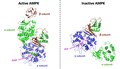 Active and Inactive AMPK
-
AMP-activated protein kinase
-
AMP-activated protein kinase
