Maejap-gwa: Difference between revisions
CSV import Tags: mobile edit mobile web edit |
CSV import |
||
| Line 26: | Line 26: | ||
{{Korea-food-stub}} | {{Korea-food-stub}} | ||
{{food-stub}} | {{food-stub}} | ||
<gallery> | |||
File:Maejap-gwa.jpg|Maejap-gwa | |||
File:Hodu-jeonggwa_and_maejapgwa.jpg|Hodu-jeonggwa and maejapgwa | |||
</gallery> | |||
Latest revision as of 02:12, 17 February 2025
Maejap-gwa is a traditional Korean confectionery, often categorized under the broader term of Hangwa. It is a type of Yugwa, which is a deep-fried sweet made from glutinous rice flour. Maejap-gwa is unique due to its distinctive shape and the use of Jujube paste as a filling.
History[edit]
The history of Maejap-gwa dates back to the Joseon Dynasty, where it was often served at royal banquets and traditional ceremonies. The name "Maejap-gwa" is derived from the Korean words "Mae" meaning "to bury" and "Jap" meaning "Jujube", referring to the method of burying the jujube paste within the dough.
Preparation[edit]
The preparation of Maejap-gwa involves several steps. The dough is made from glutinous rice flour, honey, and ginger juice. This is then rolled out and cut into small pieces. Each piece is filled with jujube paste, folded over, and sealed. The filled dough is then deep-fried until golden brown. After frying, it is coated in a syrup made from honey and ginger juice, and then dusted with ground cinnamon and pine nuts.
Cultural Significance[edit]
Maejap-gwa holds a significant place in Korean culture. It is often served during traditional Korean holidays such as Chuseok and Seollal, and is also a popular gift item. Its unique taste and texture, combined with its rich history, make it a beloved part of Korean culinary tradition.
See Also[edit]

-
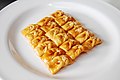 Maejap-gwa
 -
 Hodu-jeonggwa and maejapgwa


