Lotus seed: Difference between revisions
CSV import |
CSV import |
||
| Line 29: | Line 29: | ||
[[Category:Traditional Chinese medicine]] | [[Category:Traditional Chinese medicine]] | ||
{{food-stub}} | {{food-stub}} | ||
<gallery> | |||
File:Lotus_seed.jpg|Lotus seed | |||
File:Dried_lotus_seeds_snack.jpg|Dried lotus seeds snack | |||
</gallery> | |||
Latest revision as of 02:10, 17 February 2025
Lotus seed or Lotus nut is the seed of plants in the genus Nelumbo, particularly the species Nelumbo nucifera. The seeds are of great importance in Asian cuisine and are used extensively in traditional Chinese medicine and in Chinese desserts. The seeds are harvested in the late summer and early autumn, and are dried before they can be used.
Description[edit]
Lotus seeds are oval or spherical in shape and are generally white or beige in color. They have a hard outer shell, and a soft and starchy center. The center of the seed is hollow since the lotus plant is an aquatic perennial.
Culinary Uses[edit]
In Asian cuisine, lotus seeds are often used in soups, desserts, and congee. They can be eaten raw or cooked, and are often used in recipes for their health benefits. In Chinese cuisine, lotus seeds are often used in sweet desserts such as Mooncake and Lotus seed paste, which is a popular filling for mooncakes.
Health Benefits[edit]
Lotus seeds are known for their health benefits. They are a good source of protein, magnesium, potassium, and phosphorus. They also contain a small amount of zinc, iron, and fiber. In traditional Chinese medicine, lotus seeds are believed to have a soothing effect on the body and are used to treat various conditions such as insomnia, high blood pressure, and heart conditions.
Cultivation[edit]
Lotus seeds are cultivated in water gardens. They are harvested in the late summer and early autumn. The seeds are then dried and can be stored for a long time.
See Also[edit]

-
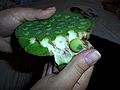 Lotus seed
 -
 Dried lotus seeds snack


