Coracoclavicular ligament: Difference between revisions
CSV import |
CSV import |
||
| Line 30: | Line 30: | ||
{{Anatomy-stub}} | {{Anatomy-stub}} | ||
<gallery> | |||
File:Gray326.png|Coracoclavicular ligament - Image 1 | |||
File:Gray328.png|Coracoclavicular ligament - Image 2 | |||
</gallery> | |||
Latest revision as of 02:09, 17 February 2025
Coracoclavicular Ligament[edit]
The coracoclavicular ligament is a crucial anatomical structure that connects the clavicle (collarbone) to the coracoid process of the scapula (shoulder blade). It plays a significant role in stabilizing the acromioclavicular joint (AC joint), which is located at the point where the clavicle meets the acromion process of the scapula.
Anatomy[edit]
The coracoclavicular ligament consists of two distinct ligaments: the trapezoid ligament and the conoid ligament. These ligaments are named based on their shape and attachment points. The trapezoid ligament is broader and attaches to the lateral aspect of the clavicle, while the conoid ligament is more conical and attaches to the medial aspect of the clavicle.
The trapezoid ligament originates from the coracoid process and inserts into the trapezoid line on the clavicle. On the other hand, the conoid ligament originates from the coracoid process and inserts into the conoid tubercle on the clavicle. Together, these ligaments provide stability and prevent excessive upward displacement of the clavicle.
Function[edit]
The primary function of the coracoclavicular ligament is to provide stability to the AC joint. It acts as a strong support structure, preventing the clavicle from dislocating or separating from the scapula during various shoulder movements. The ligament also helps to transmit forces from the upper limb to the axial skeleton, allowing for efficient movement and load-bearing.
Injuries[edit]
Injuries to the coracoclavicular ligament can occur due to trauma, such as a direct blow to the shoulder or a fall onto an outstretched arm. These injuries are commonly referred to as AC joint separations or dislocations. The severity of the injury can vary, ranging from a mild sprain to a complete tear of the ligament.
Treatment for coracoclavicular ligament injuries depends on the severity and the individual's specific circumstances. Conservative management, including rest, ice, compression, and elevation (RICE), along with physical therapy, is often sufficient for mild to moderate injuries. However, severe cases may require surgical intervention to repair or reconstruct the damaged ligament.
Conclusion[edit]
The coracoclavicular ligament is a vital structure that provides stability to the AC joint and plays a crucial role in shoulder function. Understanding its anatomy, function, and potential injuries is essential for healthcare professionals involved in the diagnosis and treatment of shoulder-related conditions.

-
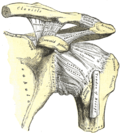 Coracoclavicular ligament - Image 1
 -
 Coracoclavicular ligament - Image 2


