Coup contrecoup injury: Difference between revisions
CSV import Tags: mobile edit mobile web edit |
CSV import Tags: mobile edit mobile web edit |
||
| Line 39: | Line 39: | ||
{{Medicine-stub}} | {{Medicine-stub}} | ||
<gallery> | |||
File:Contrecoup.svg|Contrecoup injury illustration | |||
File:Coup_injury.jpg|Coup injury illustration | |||
</gallery> | |||
Latest revision as of 02:08, 17 February 2025
Coup and contrecoup injuries are types of traumatic brain injuries (TBI) that occur as a result of a forceful impact to the head. These injuries are characterized by damage to the brain on both the site of impact (coup injury) and the opposite side of the brain (contrecoup injury). This article will delve into the mechanisms, symptoms, diagnosis, and treatment of coup and contrecoup injuries, as well as their implications for affected individuals.
Mechanism of Injury[edit]
Coup and contrecoup injuries occur when the force of an impact causes the brain to move inside the skull. In a coup injury, the brain is injured directly under the site of impact, while a contrecoup injury occurs on the side opposite the impact. This movement can cause the brain to collide with the internal bony structures of the skull, leading to bruising (contusion), bleeding (hemorrhage), and tissue damage.
These injuries are commonly seen in situations involving rapid acceleration or deceleration of the head, such as in vehicle accidents, falls, or sports-related impacts. The severity of the injury can vary widely, depending on the force of the impact and the individual's specific circumstances.
Symptoms[edit]
Symptoms of coup and contrecoup injuries can range from mild to severe and may include:
- Headache
- Confusion
- Dizziness
- Nausea or vomiting
- Loss of consciousness
- Memory disturbances
- Mood changes
- Sensory deficits
- Motor deficits
The symptoms experienced can provide clues about the severity and location of the brain injury.
Diagnosis[edit]
Diagnosis of coup and contrecoup injuries typically involves a combination of clinical assessment and imaging studies. A thorough medical history and physical examination are essential to assess the extent of the injury and rule out other conditions. Imaging techniques such as CT scans or MRI are crucial for visualizing the brain and identifying areas of damage.
Treatment[edit]
Treatment for coup and contrecoup injuries varies based on the severity of the injury. Mild injuries may only require rest and monitoring, while more severe injuries could necessitate medical or surgical intervention to relieve pressure inside the skull, repair skull fractures, or address other complications. Rehabilitation services, including physical therapy, occupational therapy, and speech therapy, may be necessary to help the individual regain function and independence.
Prognosis[edit]
The prognosis for individuals with coup and contrecoup injuries depends on the severity of the injury, the speed of intervention, and the individual's overall health. While some may recover fully, others may experience long-term effects, such as cognitive deficits, physical impairments, or emotional and behavioral changes.
Prevention[edit]
Preventing coup and contrecoup injuries involves taking measures to protect the head from impacts. This includes wearing appropriate safety equipment during sports and recreational activities, using seat belts in vehicles, and ensuring safe environments to reduce the risk of falls.
Conclusion[edit]
Coup and contrecoup injuries are serious conditions that require prompt medical attention. Understanding the mechanisms, symptoms, and treatment options for these injuries is crucial for effective management and recovery. With appropriate care and rehabilitation, many individuals can make significant recoveries, though challenges may persist for some.

-
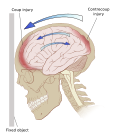 Contrecoup injury illustration
 -
 Coup injury illustration


