EIF4E: Difference between revisions
CSV import Tags: mobile edit mobile web edit |
CSV import |
||
| Line 24: | Line 24: | ||
[[Category:Genes]] | [[Category:Genes]] | ||
[[Category:Molecular biology]] | [[Category:Molecular biology]] | ||
= EIF4E = | |||
<gallery> | |||
File:EIF4E_with_7MetGTP.png|EIF4E with 7-Methylguanosine triphosphate | |||
File:EIF4E.png|EIF4E | |||
</gallery> | |||
Latest revision as of 02:08, 17 February 2025
EIF4E (Eukaryotic Translation Initiation Factor 4E) is a protein that in humans is encoded by the EIF4E gene. It is a part of the eukaryotic translation initiation factor family, which plays a crucial role in the initiation phase of protein synthesis.
Function[edit]
EIF4E is a cap-binding protein that binds to the 5' cap of mRNA and is required for the initiation of protein translation. It is a critical component of the eIF4F complex, which is involved in the recognition of the mRNA cap, ATP-dependent unwinding of 5'-terminal secondary structure, and recruitment of mRNA to the ribosome.
Clinical Significance[edit]
Alterations in the expression and activity of EIF4E have been linked to a variety of cancers, including breast, colon, prostate, and lung cancers. Overexpression of EIF4E can lead to increased translation of specific mRNAs that promote cell proliferation and survival, contributing to tumorigenesis. Therefore, EIF4E is considered a potential target for cancer therapy.
Research[edit]
Research on EIF4E has focused on understanding its role in cancer development and exploring its potential as a therapeutic target. Several inhibitors of EIF4E have been developed and are currently being tested in preclinical and clinical trials.
See Also[edit]
References[edit]
<references />

EIF4E[edit]
-
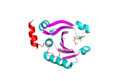 EIF4E with 7-Methylguanosine triphosphate
 -
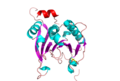 EIF4E
EIF4E


