Observational error: Difference between revisions
CSV import Tags: mobile edit mobile web edit |
CSV import |
||
| Line 35: | Line 35: | ||
[[Category:Error]] | [[Category:Error]] | ||
{{Science-stub}} | {{Science-stub}} | ||
<gallery> | |||
File:Measurement_distribution_with_systematic_and_random_errors.svg|Measurement distribution with systematic and random errors | |||
</gallery> | |||
Latest revision as of 02:05, 17 February 2025
Observational error, also known as measurement error, refers to the difference between the value measured in a scientific experiment and the true value of what is being measured. This type of error is inherent in all types of scientific measurements and can arise from a variety of sources, making it a critical concept in both the theory and practice of science, particularly in fields such as physics, chemistry, biology, and medicine. Understanding and minimizing observational errors is essential for improving the accuracy and reliability of experimental results.
Types of Observational Error[edit]
Observational errors can be broadly classified into two main types: Systematic error and Random error.
Systematic Error[edit]
Systematic error, also known as bias, causes measurements to consistently deviate in the same direction from the true value. These errors are predictable and typically stem from flawed experimental design, faulty measuring instruments, or external influences that are not accounted for in the experimental setup. Examples include a scale that always reads 5 grams too heavy or a stopwatch that runs slow. Systematic errors can often be identified and corrected by calibrating equipment or revising experimental procedures.
Random Error[edit]
Random error, in contrast, causes measurements to fluctuate unpredictably around the true value, due to inherently unpredictable variations in the measurement process. These errors arise from factors such as environmental changes, observer variability, and inherent limitations of measuring instruments. Unlike systematic errors, random errors cannot be completely eliminated, but their effects can be minimized through statistical analysis and by increasing the number of observations.
Sources of Observational Error[edit]
Observational errors can originate from a variety of sources, including:
- Instrumental errors: Imperfections or malfunctions in measuring devices.
- Environmental errors: Variations in experimental conditions, such as temperature, humidity, or pressure.
- Observational errors: Mistakes or limitations in the observer's ability to measure accurately, including parallax errors and estimation errors.
- Theoretical errors: Incorrect assumptions or models used in the interpretation of data.
Minimizing Observational Error[edit]
To minimize observational errors, scientists employ several strategies:
- Calibration of instruments to ensure their accuracy.
- Use of control experiments to identify and quantify systematic errors.
- Repetition of measurements and use of statistical methods to reduce the impact of random errors.
- Rigorous training of observers to reduce human error.
Impact of Observational Error[edit]
The presence of observational errors can significantly impact the validity and reliability of scientific research. In fields such as medicine, where accurate measurements are crucial for diagnosis and treatment, minimizing these errors is of paramount importance. Similarly, in physics and chemistry, precision in measurement is essential for testing theories and models.
Conclusion[edit]
Observational error is an unavoidable aspect of scientific research that can significantly affect the accuracy of measurements. By understanding the types and sources of these errors, scientists can employ strategies to minimize their impact, thereby enhancing the reliability of experimental results.

-
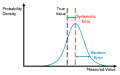 Measurement distribution with systematic and random errors

