Trional: Difference between revisions
CSV import |
CSV import |
||
| Line 36: | Line 36: | ||
[[Category:Hypnotics]] | [[Category:Hypnotics]] | ||
[[Category:Sulfonal derivatives]] | [[Category:Sulfonal derivatives]] | ||
== Trional == | |||
<gallery> | |||
File:Trional.svg|Chemical structure of Trional | |||
File:Trional_ball-and-stick.png|Ball-and-stick model of Trional | |||
</gallery> | |||
Latest revision as of 02:05, 17 February 2025
Trional[edit]


Trional is a sedative and hypnotic drug that was first introduced in the late 19th century. It is chemically known as 2,2-bis(ethylsulfonyl)propane and belongs to the class of sulfonal derivatives. Trional was widely used in the early 20th century for its calming effects and ability to induce sleep.
History[edit]
Trional was first synthesized in 1888 by the German chemist Eugen Baumann. It was developed as a derivative of sulfonal, which was already known for its sedative properties. Trional gained popularity as a sleep aid and was marketed under various brand names. It was commonly used in the treatment of insomnia and other sleep disorders.
Chemical Properties[edit]
Trional is a white crystalline powder that is soluble in alcohol and ether, but only slightly soluble in water. Its chemical formula is C8H16O4S2. The compound is characterized by the presence of two ethylsulfonyl groups attached to a central propane structure.
Pharmacology[edit]
Trional acts as a central nervous system depressant. It enhances the activity of the inhibitory neurotransmitter gamma-aminobutyric acid (GABA) in the brain, leading to sedative and hypnotic effects. The drug was used to promote sleep and reduce anxiety, but its use declined with the development of safer and more effective medications.
Medical Use[edit]
In the past, Trional was prescribed for the treatment of insomnia and anxiety. However, due to its potential for addiction and side effects, its use has been largely discontinued. Modern benzodiazepines and other hypnotics have replaced Trional in clinical practice.
Side Effects[edit]
Common side effects of Trional included drowsiness, dizziness, and headache. In some cases, prolonged use could lead to tolerance and dependence. Overdose of Trional could result in severe respiratory depression and coma.
Related Pages[edit]
References[edit]
- Baumann, E. (1888). "Ueber einige neue Derivate des Methans". Berichte der deutschen chemischen Gesellschaft, 21(2), 2743-2745.
- Sneader, W. (2005). "Drug Discovery: A History". John Wiley & Sons.
Trional[edit]
-
 Chemical structure of Trional
 -
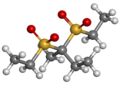 Ball-and-stick model of Trional
