Object sexuality: Difference between revisions
CSV import |
CSV import |
||
| Line 28: | Line 28: | ||
[[Category:Paraphilias]] | [[Category:Paraphilias]] | ||
{{Sexuality-stub}} | {{Sexuality-stub}} | ||
<gallery> | |||
File:Château_de_Versailles,_salon_des_nobles,_Pygmalion_priant_Vénus_d'animer_sa_statue,_Jean-Baptiste_Regnault.jpg|Pygmalion praying to Venus to animate his statue, by Jean-Baptiste Regnault | |||
</gallery> | |||
Latest revision as of 02:04, 17 February 2025
Object sexuality or Objectum sexuality (OS) is a form of sexual orientation characterized by a strong emotional, romantic, and often sexual attraction towards inanimate objects. Individuals with this preference are referred to as objectophiles or object-sexuals.
History[edit]
The term "Objectum Sexuality" was coined in the early 1970s by Eija-Riitta Berliner-Mauer, a Swedish woman who claimed to be in love with the Berlin Wall. The phenomenon, however, has been documented in various cultures and eras, suggesting that it is not a recent development.
Characteristics[edit]
Objectum sexuality is distinct from sexual fetishism, in that the objectophile has a profound emotional and romantic connection with the object of their affection, rather than a purely sexual interest. The objects of attraction can vary widely and can include buildings, vehicles, and more mundane objects such as fences or electronic equipment.
Objectophiles often attribute human-like qualities to their objects, such as gender, personality, feelings, and the ability to communicate. This is a form of anthropomorphism, where human characteristics are attributed to non-human entities.
Psychological Perspectives[edit]
From a psychological perspective, objectum sexuality is not currently recognized as a distinct sexual orientation by the American Psychological Association or the World Health Organization. It is often viewed as a form of paraphilia, a condition characterized by abnormal sexual desires.
Societal Reactions and Media[edit]
Societal reactions to objectum sexuality are mixed. Some view it as a harmless eccentricity, while others see it as a mental disorder. The media has often portrayed objectum sexuality in a sensationalist manner, focusing on the more unusual aspects of the orientation.
Objectum sexuality has been the subject of several documentaries, including the 2010 film "Married to the Eiffel Tower", which explores the lives of several women who identify as object-sexuals.
See Also[edit]
References[edit]
<references />
.svg)
-
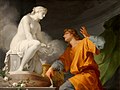 Pygmalion praying to Venus to animate his statue, by Jean-Baptiste Regnault

