World Toilet Organization: Difference between revisions
CSV import |
CSV import Tags: mobile edit mobile web edit |
||
| Line 37: | Line 37: | ||
* [https://www.who.int/water_sanitation_health/en/ World Health Organization - Water, Sanitation, and Hygiene] | * [https://www.who.int/water_sanitation_health/en/ World Health Organization - Water, Sanitation, and Hygiene] | ||
{{dictionary-stub1}} | {{dictionary-stub1}} | ||
<gallery> | |||
File:World_Toilet_Day_celebrations_in_Senegal_2014.jpg|World Toilet Day celebrations in Senegal, 2014 | |||
</gallery> | |||
Latest revision as of 01:57, 17 February 2025
World Toilet Organization[edit]
The World Toilet Organization (WTO) is a global non-profit organization that aims to improve sanitation conditions and promote access to clean and safe toilets worldwide. Founded in 2001, the organization has been instrumental in raising awareness about the importance of proper sanitation and advocating for better toilet facilities.
History[edit]
The World Toilet Organization was established by Jack Sim, a Singaporean entrepreneur, who recognized the urgent need to address the global sanitation crisis. Inspired by a visit to a slum in Cambodia, where he witnessed the dire conditions people lived in due to lack of proper sanitation, Sim decided to take action.
In 2001, Sim founded the World Toilet Organization with the goal of creating a platform for collaboration and knowledge-sharing among various stakeholders involved in sanitation. The organization's first major initiative was the inaugural World Toilet Summit held in Singapore in 2001, which brought together experts, policymakers, and activists from around the world to discuss and find solutions to the sanitation challenges.
Objectives[edit]
The World Toilet Organization has set several key objectives to achieve its mission of improving global sanitation:
1. Advocacy and Awareness: The organization aims to raise awareness about the importance of sanitation and advocate for improved toilet facilities. It works closely with governments, NGOs, and other stakeholders to promote policies and initiatives that prioritize sanitation.
2. Capacity Building: The WTO provides training and capacity-building programs to individuals and organizations involved in sanitation projects. These programs aim to enhance knowledge and skills in areas such as toilet design, maintenance, and hygiene practices.
3. Research and Innovation: The organization conducts research and promotes innovation in the field of sanitation. It collaborates with academic institutions and industry experts to develop new technologies and approaches that can address sanitation challenges effectively.
4. Partnerships and Collaboration: The WTO actively seeks partnerships and collaborations with governments, NGOs, and businesses to leverage resources and expertise. By working together, the organization aims to accelerate progress towards achieving universal access to clean and safe toilets.
Impact and Recognition[edit]
Over the years, the World Toilet Organization has made significant contributions to improving sanitation conditions globally. Its initiatives have helped raise awareness about the importance of sanitation and have led to the implementation of numerous sanitation projects in various countries.
The organization's efforts have been recognized internationally, and it has received several awards and accolades for its work. In 2013, the World Toilet Organization was granted consultative status with the United Nations Economic and Social Council (ECOSOC), further enhancing its ability to advocate for improved sanitation at the global level.
See Also[edit]
References[edit]
<references />
External Links[edit]
- Official website of the World Toilet Organization
- United Nations - Water and Sanitation
- World Health Organization - Water, Sanitation, and Hygiene

-
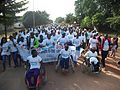 World Toilet Day celebrations in Senegal, 2014

