Pterygota: Difference between revisions
CSV import |
CSV import Tags: mobile edit mobile web edit |
||
| Line 35: | Line 35: | ||
[[Category:Entomology]] | [[Category:Entomology]] | ||
[[Category:Ecology]] | [[Category:Ecology]] | ||
<gallery> | |||
Pterygota | |||
File:Gaint_Honey_Bee_(Apis_dorsata)_on_Tribulus_terrestris_W_IMG_1020.jpg|Giant Honey Bee on Tribulus terrestris | |||
</gallery> | |||
Revision as of 01:54, 17 February 2025
Pterygota is a taxonomic class of insects that includes the majority of winged insects. The name "Pterygota" is derived from the Greek words "pteryx," meaning wing, and "gonia," meaning angle or joint. This class is one of the most diverse and successful groups of organisms on Earth, with over one million described species.
Taxonomy
Pterygota belongs to the phylum Arthropoda and the subphylum Hexapoda, which includes insects with six legs. Within the class Pterygota, there are two major subclasses: Paleoptera and Neoptera.
Paleoptera
The subclass Paleoptera consists of primitive winged insects that are unable to fold their wings flat against their bodies. This group includes two orders: Ephemeroptera, commonly known as mayflies, and Odonata, which includes dragonflies and damselflies. These insects have a unique wing structure and are considered living fossils due to their ancient lineage.
Neoptera
The subclass Neoptera comprises the vast majority of winged insects. Unlike Paleoptera, Neoptera insects have the ability to fold their wings flat against their bodies. This subclass is further divided into several orders, including Coleoptera (beetles), Lepidoptera (butterflies and moths), Diptera (flies), Hymenoptera (ants, bees, and wasps), and many others.
Characteristics
Pterygota insects share several common characteristics that distinguish them from other arthropods. One of the most notable features is the presence of wings, which are specialized outgrowths of the exoskeleton. Wings allow insects to fly, providing them with a significant advantage in terms of mobility and access to resources.
Another characteristic of Pterygota is their metamorphic life cycle. Most insects undergo complete metamorphosis, which includes four distinct stages: egg, larva, pupa, and adult. This life cycle allows insects to exploit different ecological niches and adapt to various environments.
Importance
Pterygota insects play crucial roles in ecosystems and have significant impacts on human societies. They are important pollinators, aiding in the reproduction of flowering plants and the production of fruits and seeds. In addition, many insects are decomposers, breaking down organic matter and recycling nutrients in the environment.
Furthermore, Pterygota insects serve as a vital food source for other organisms, including birds, reptiles, amphibians, and mammals. They also have economic importance, both as pests and beneficial organisms. Some insects, such as bees, are essential for crop pollination, while others, like mosquitoes, can transmit diseases to humans.
Conservation
Due to their ecological importance and biodiversity, the conservation of Pterygota insects is crucial. Habitat destruction, pollution, climate change, and the use of pesticides are major threats to insect populations worldwide. Conservation efforts focus on preserving natural habitats, promoting sustainable agricultural practices, and raising awareness about the importance of insects in ecosystems.
See also
References
<references />
-
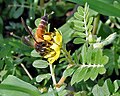 Giant Honey Bee on Tribulus terrestris
_on_Tribulus_terrestris_W_IMG_1020.jpg)
