Tympanic plexus: Difference between revisions
CSV import |
CSV import Tags: mobile edit mobile web edit |
||
| Line 39: | Line 39: | ||
[[Category:Human anatomy]] | [[Category:Human anatomy]] | ||
[[Category:Peripheral nervous system]] | [[Category:Peripheral nervous system]] | ||
<gallery> | |||
File:Tympanic_plexus.png|Tympanic plexus | |||
File:Gray911.png|Gray's Anatomy Plate 911 | |||
File:Gray788.png|Gray's Anatomy Plate 788 | |||
</gallery> | |||
Revision as of 01:53, 17 February 2025
A network of nerves in the middle ear
The tympanic plexus is a network of nerves located in the middle ear. It is primarily involved in the innervation of the mucous membrane of the middle ear cavity, the mastoid air cells, and the auditory tube.
Anatomy
The tympanic plexus is formed on the promontory of the middle ear by the tympanic nerve, a branch of the glossopharyngeal nerve (cranial nerve IX), and by sympathetic fibers from the carotid plexus.
Tympanic nerve
The tympanic nerve arises from the inferior ganglion of the glossopharyngeal nerve. It enters the middle ear through the tympanic canaliculus and contributes to the formation of the tympanic plexus.
Sympathetic fibers
The sympathetic fibers that contribute to the tympanic plexus originate from the superior cervical ganglion and reach the plexus via the carotid plexus.
Branches
The tympanic plexus gives rise to several branches:
- The lesser petrosal nerve, which carries parasympathetic fibers to the otic ganglion.
- Branches that supply the mucous membrane of the middle ear, mastoid air cells, and the auditory tube.
Function
The primary function of the tympanic plexus is to provide sensory innervation to the mucous membrane of the middle ear and to carry parasympathetic fibers to the otic ganglion. These parasympathetic fibers are involved in the regulation of secretions from the parotid gland.
Clinical significance
Damage to the tympanic plexus can result in loss of sensation in the middle ear and may affect the function of the parotid gland. Conditions such as glossopharyngeal neuralgia can involve the tympanic plexus, leading to pain in the ear and throat.
Images


Related pages
References
- Standring, S. (2020). Gray's Anatomy: The Anatomical Basis of Clinical Practice. 42nd edition. Elsevier.
- Moore, K. L., Dalley, A. F., & Agur, A. M. R. (2018). Clinically Oriented Anatomy. 8th edition. Wolters Kluwer.
-
Tympanic plexus
-
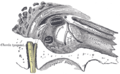 Gray's Anatomy Plate 911
 -
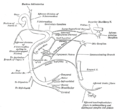 Gray's Anatomy Plate 788

